Pace layering, Estonia and what Ireland can learn about transformation at scale
Some of the most useful thinking comes from putting unrelated things beside each other. At the moment I am thinking a lot about transformation at scale/pace and about the human side of change.
I have always worked at edges and margins: between strategy and delivery, policy and practice, design and data, organisations and communities. These are not tidy places. They are where language changes, incentives clash, and people have to translate. But that is precisely why they are productive. The centre already knows its own logic. The edge is where a different logic becomes visible.
Fast layers, slow roots: what Ireland can learn
I have been sitting with two very different things: Stewart Brand’s idea of pace layering and an OECD assessment of Estonia’s public-sector innovation capacity.
One is a framework about how complex systems learn. The other is a report about how a small, digitally advanced state tries to turn good ideas into change that lasts. Put them beside each other and both become more useful.
Brand’s point is simple: healthy systems do not all move at the same speed. Fashion, commerce and technology change quickly. Governance, infrastructure, culture and the living world change slowly. The fast layers generate novelty; the slow layers hold memory, constraint and continuity. Neither is superior. A system becomes resilient when the fast layers can experiment while the slow layers can absorb, test and remember what matters. The value is not in choosing one speed over another. It is in designing the relationship between them.
Estonia gives that abstraction a practical shape.
Its digital state did not become an international reference point because it had lots of clever pilots. It became durable because fast innovation sat on slow foundations: digital identity, secure data exchange, legal mandates, shared infrastructure and, crucially, public trust. The fast layer could move because the slow layer was strong enough to carry it.
But Estonia also shows the harder truth. Innovation is not the same as scale. The OECD assessment found that while many public-sector innovations reached implementation, far fewer were scaled. Ideas got stuck between prototype, evaluation, procurement, legislation, funding and decision-making.
That is exactly what pace layering predicts.
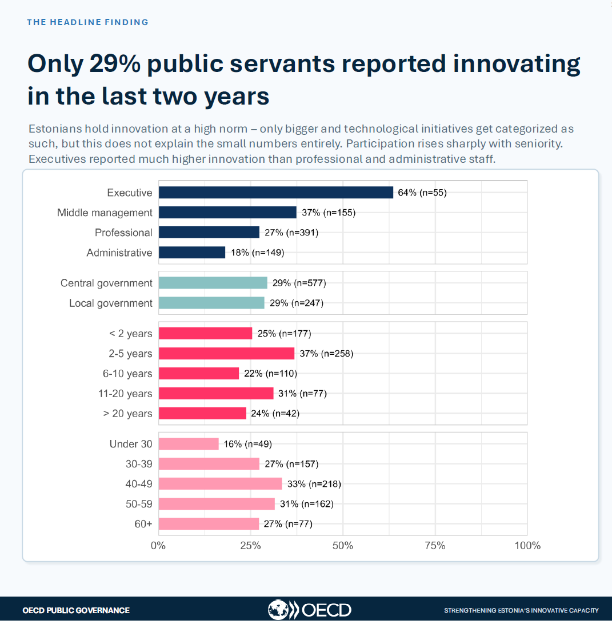
If you know my work you’ll know my sentiment on innovation theatre and design thinking. So this graph had to be included, ticking my confirmation bias.
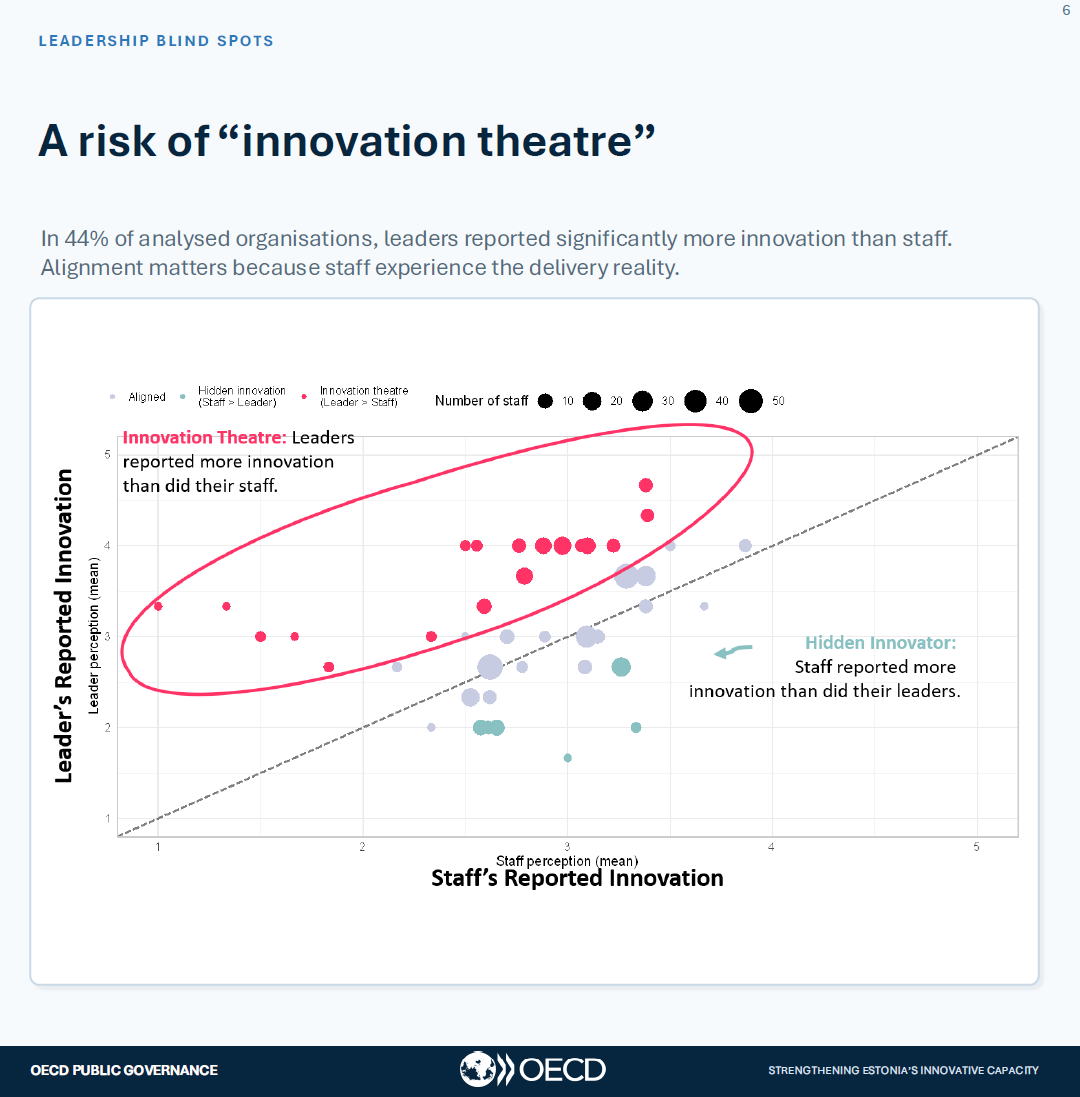
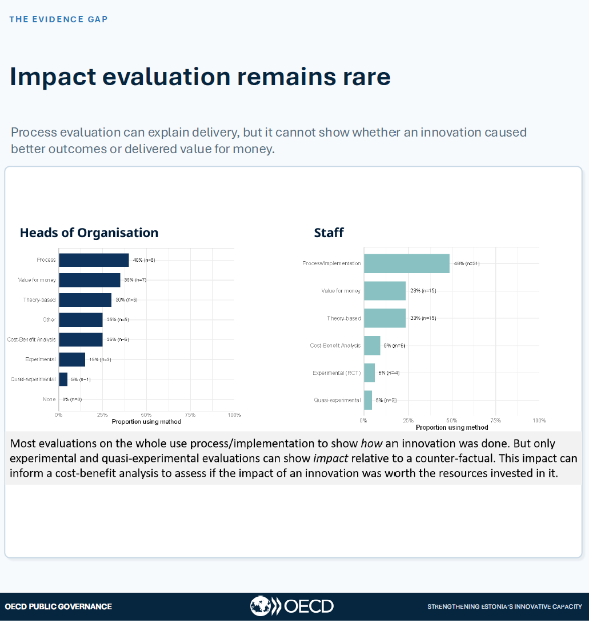
A pilot can move quickly. A procurement process cannot. A leadership team can agree a new way of working in a workshop. A culture, a budget line, a piece of legislation or an accountability system takes much longer. When we expect all of those to move together, we either get frustrated or we mistake a demonstration or prototype for transformation.
Why putting two things together helps
This is why I like taking two apparently unrelated things and thinking with them. A framework alone can become a neat diagram. A case study alone can become a list of lessons. But when you hold them together, each interrupts the other. Pace layering stops Estonia becoming a story about technology. Estonia stops pace layering becoming a piece of systems theory that floats above real organisations.
In living systems, insight often comes from relationship rather than from the parts. A forest is not just trees. A team is not just a set of roles. A strategy is not just a plan. What matters is the pattern of connections: what feeds what, what slows what down, what allows something new to take root.
Brand’s layers are not a hierarchy. They are more like an ecology. The quick layer needs the slow layer. The slow layer needs contact with the quick layer, or it becomes rigid. The trouble starts when one layer tries to do the job of another: when culture is expected to change in a six-week sprint, or when infrastructure is treated as a quick fix.
For BDT, this reinforces something I keep returning to: sustained change happens when the right conditions are present. You cannot mandate aliveness. You create the conditions for it.
This is the work I am interested in at BDT: designing the connective tissue between experimentation and institution, so that innovation becomes transformation.
When I work with leaders, public bodies, communities or teams, I am increasingly asking:
- What is moving fast here? Ideas, energy, experiments, relationships, emerging needs.
- What is moving slowly? Governance, funding, habits, trust, policy, infrastructure, identity.
- Where is the friction? Is it a genuine tension that protects the system, or a blockage that needs attention?
- What needs to be held steady while something new is tested?
- What has to change in the slow layer for the fast layer to scale?
In a living systems lens these translate to
- What is abundant here?
- What is scare here?
- What does the energy feel like?
- What can we test in a small way within the current pace while holding the direction of travel?
- What conditions are required and in what order for scale?
A pilot is not a failure because it does not scale immediately. It may be doing exactly what a fast layer should do: generating evidence, relationships and learning. The failure is when nobody designs the route from learning into the slower structures that make change durable.
Equally, a slow layer is not automatically obstructive. Governance, standards and shared infrastructure can be what allow many people to act without starting from scratch every time.
The OECD ranks Ireland seventh of 36 countries on the 2025 Digital Government Index, with particular strength in digital-by-design, shared platforms, user-centred services and data-driven government. Is that how the population ranks Ireland it?
The Estonian comparison points to a different question. Ireland’s challenge is not simply to generate more digital projects or innovation pilots. It is to make sure the fast-moving work of experimentation is connected to the slower structures; interoperability, procurement, governance, capability, trust and culture, that allow change to become normal.
Ireland has strong shared foundations, including MyGovID and other common platforms, but the OECD finds that a full interoperability system and clear requirements for data exchange between public bodies are not yet fully in place. That matters because interoperability is the quiet infrastructure of transformation. Without it, citizens and businesses keep supplying the same information to different parts of the state, and each organisation keeps solving similar problems on its own.
The lesson from Estonia is not “copy Estonia”. It is: invest deliberately in the shared rails = identity, data exchange, registries, notifications, common standards and reusable components. So that individual services can improve without every agency building separately.
Ireland also has pockets of excellent innovation, but the OECD has previously described public-service innovation as patchy and in need of a more systemic, strategic approach. A pilot is not meant to prove that an idea will work everywhere. Its job is to create evidence, relationships and learning quickly. The real design question is what happens next: who reviews the learning, what evidence is needed, which rules need to change, and how the idea moves into policy, procurement or routine delivery.
Procurement is one of Ireland’s most important slow layers.
The OECD argues that Ireland needs a clearer national vision for digital procurement, including explicit boundaries for risk, emerging technology and the use of procurement to foster innovation. This is where many promising ideas die. A team may design a better service, but if procurement can only buy a fully specified, low-risk solution, the system has quietly ruled out learning.
On the horizon is a Digital Meitheal 2026
Digital Meitheal 2026 in Drogheda feels like more than a good event. It is a small, practical intervention in the relationship between fast and slow layers. An associate working in supporting Better Public Services sent me an invite. It’s unlikely I’ll be attending a two day hackathon type event with no current client pathway there.
A meitheal is an old Irish practice: neighbours arriving to bring in the harvest because the work was too big for one household. Digital Meitheal applies that logic to public and civic services. People bring real challenges, share what they have, build together and leave with a next action. No spectators.
That is pace layering made tangible.
The fast layer is the two days in Drogheda: people meeting, framing problems, sharing patterns, making prototypes, testing assumptions and building demonstrators. The medium layer is what they create together: reusable components, data models, service patterns, pilots and shared evidence. The slow layer is the harder work afterwards: procurement, governance, policy, organisational routines, trust and the willingness to keep collaborating after everyone goes home.
The event’s emphasis on reusable beats bespoke is particularly important.
Ireland does not need every county, agency, charity or community organisation to solve the same problem separately.
It needs enough shared seams; standards, credentials, identity, data models, service patterns enabling local teams design for their place without rebuilding the plumbing every time.
The Drogheda town-centre baseline is a good example. It is not just a data-collection exercise. It creates a shared, repeatable evidence base before major regeneration and transport changes, so that future decisions can be made with better evidence and communities can see what changed over time.
The reality is after the event:
What conditions will allow this work to continue, connect and become useful beyond the Digital Meitheal?
That means paying attention to:
- Who owns the next step after the event.
- What needs to be reusable, rather than another one-off prototype.
- Which policy, procurement or governance barriers need to be named early.
- How lived experience, frontline knowledge and technical expertise stay in the work.
- How trust is built, not assumed.
- How a local challenge can teach us something that travels.
Estonia’s experience suggests that transformation is less about heroic innovation and more about building the connective tissue between experimentation and institution. Brand would call that the relationship between fast and slow layers. A meitheal gives it an Irish form: people working together on what none of them can carry alone.
Ireland’s opportunity is to stop treating innovation, digital, procurement, data and public-service reform as separate agendas, and start designing them as one living system. The work is to pay attention to pace, protect what needs protecting, and make it easier for what is alive to take root.
Digital Meitheal is a small intervention in a much larger system. Two days will not transform Ireland. But two days can create the relationships, shared language and practical next steps that make transformation possible.
It’s simple: bring what you know, name what is stuck, work with people who see the problem differently, and leave with something that can be carried forward. Because the work of transformation is not done in the centre or at the edge alone. It happens in the conversation between them.
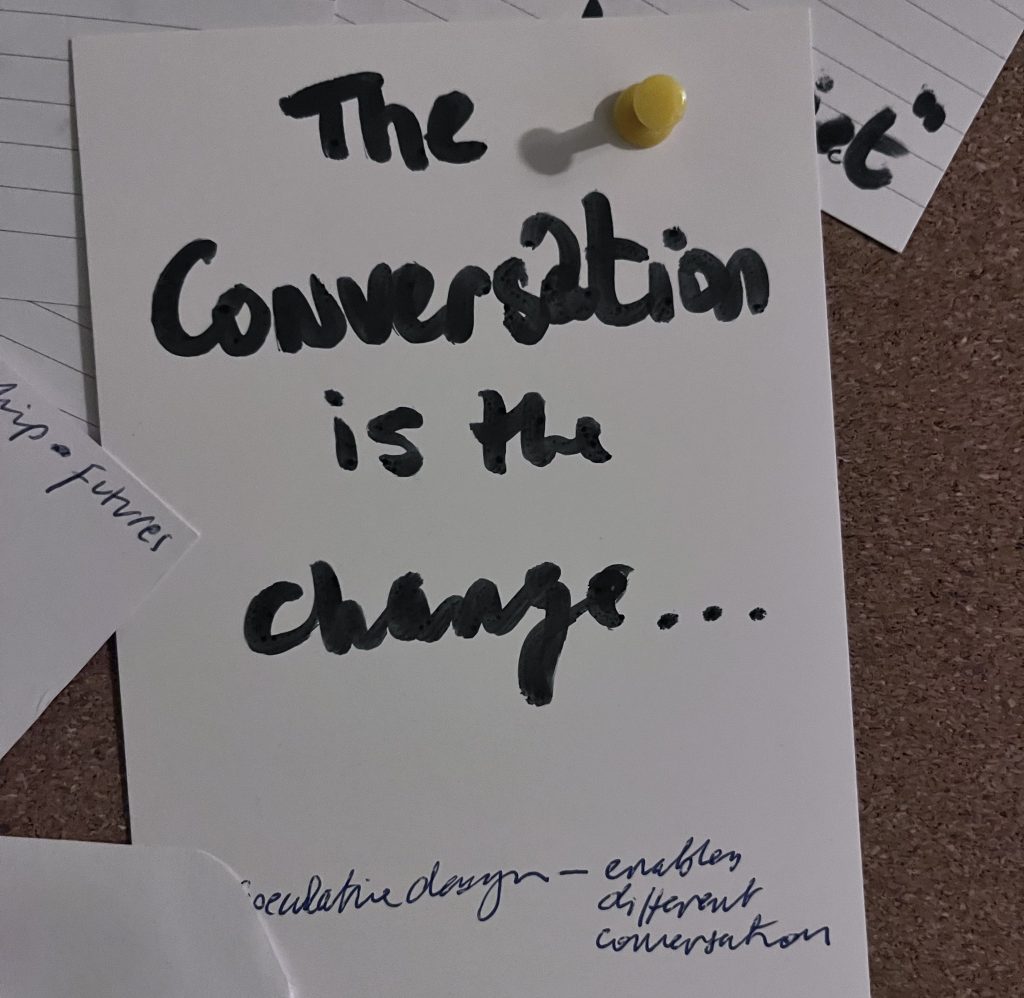
As I’ve stated recently – the conversation is the change.
In this blog I refrence:
Pace Layering: How Complex Systems Learn and Keep Learning — LONG NOW IDEAS Jan 2018, shared by Capri LaRocca during the Biomimicry for Social innovation, Leadership and Collective Action Through Nature’s Lens workshop.
Strengthening the Innovative Capacity of the Public Sector of Estonia | OECD What Estonia’s public sector innovation system reveals, and what must change next. OECD November 2026.


Leave a Reply