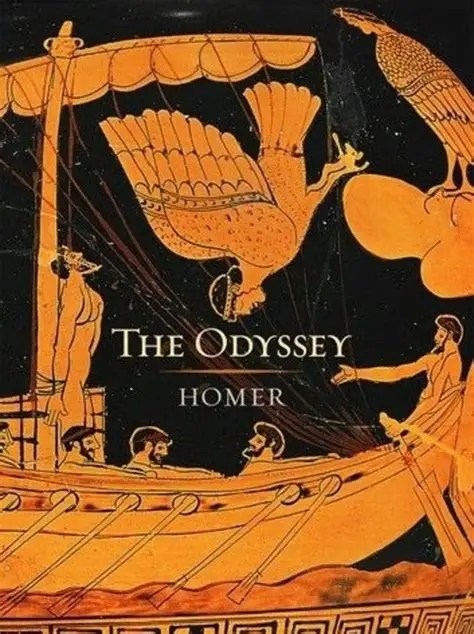
The Odyssey is a Greek Epic.
Universal Films released a film called The Odyssey, an edited retelling written and directed by Christopher Nolan, it was in the cinemas at the end of summer 2026. It became one of those event films people were talking about. Lots, lots of hype.
“You’ll love to hate it” was the comment from my eldest son, a man in his late 20’s. He, who grew up playing Lego, cars, hacking his Nintendo and single shooter games while studying the classics, art and later psychology. He thought it was the best film he ever saw. His enthrall was also behind the scenes as much as the imax cinematic experience. He knew so much not just about the original story but what Christopher Nolan was trying to do.
I was disappointed.
I was surprised I enjoyed it as much as I did but I was left sitting with a hero’s return story where all the woman were peripheral to him and a cost of $250M.
The following morning I was really trying to understand my response. I roughly knew the story, remembering a poem about a cyclops in school, Helen facinated me at some point a woman central to war. I’ve worked with the Trojan Horse metaphor over the years.
Maybe I missed something that was obvious to others but my own dissatisfaction gnawed. I wanted to understand it further.
On a fundamental level, have we no new stories to tell?
Why would someone go back to the oldest tales of classic Greek origin and retell the Odyssey?
Fantastically myths, metaphors, Gods, beasts, evil personified – mostly as women, perilous land and sea scapes, returning from war the individual heroic man. The hero’s journey.
The films production also echos this narrative. It’s enormous budget, well know and distinctive cast, advanced technologies and scale become part of the spectacle. The making of the film is presented as another heroic undertaking: a singular vision mobilising vast resources, overcoming logistical obstacles and converting risk into prestige.
Even the storytelling about the film is about an individual man, his heroic and entrepreneurial journey to cinematic excellence. His singular vision to use iMAX technology
In a world where the current moment is rife with war, geopolitical destabilisation, roling back on women’s rights, increase in authoritarian regimes, man made climate change, ecological and biodiversity loss at scales unrecoverable, tech-facisim, population displacement and forced migration because of violation of human rights and genocide plus climate chaos, the rise of the far right…
This was the story that $250,000,000 was spent on.
I experience it as deeply political in terms of who gets to make cultural excellence and spend vast resources. Partly the scale of extraction, at who’s cost and labour turns this into profit, cinematic epic and spin.
This is where the ecological and economic discomfort lies. It is not simply that the film cost a great deal of money. It is that its scale turns extraction into cultural achievement. The more resources consumed, the more serious the art appears to be.
At a time when we are being asked to live within ecological limits, we continue to celebrate excess when it is attached to elite cultural production. A $250 million epic is called ambition. The ordinary pleasures, public gatherings and improvised traditions of working-class or marginalised communities are more readily described as wasteful, disorderly or irresponsible.
The question is not whether expensive art has the right to exist. The question is what our culture is willing to fund, admire and call necessary.
We can imagine a functioning ancient warship in extraordinary detail. We can mobilise people, materials and technology to recreate the past at vast scale. Yet we seem less able, or less willing, to imagine a society organised around care, ecological reciprocity, democratic participation and welcome.
We can still imagine the hero returning from war. We struggle to imagine peace as a collective achievement.
The deepest question is therefore not whether Odysseus has changed.
This is why the film’s apparent anti-war message feels insufficient. It may show us the moral injury of the warrior, but it does not necessarily challenge the social order that makes the warrior culturally valuable. War is condemned in content while remaining magnificent in form. The film grieves violence while retaining its glamour.
It is whether the world he returns to has changed and whether anyone other than the hero is allowed to define what that change should mean.
Perhaps we need a different kind of Odyssey now. Not a story about one powerful man reclaiming his home, but a story about communities remaking home together. Not a world in which landscapes exist for heroic testing, but one in which land and sea are living relations. Not a culture that treats care as background labour, but one that understands care as the substance of political life.
Women in relation to a man
The women in the story occupy a series of familiar categories: wife, mother, queen, temptress, siren, witch, servant, monster, revenger and adulteress. They appear to represent different forms of female power, but they are frequently arranged around the male hero’s journey.
- Penelope represents home, continuity and fidelity.
- Circe represents forbidden knowledge, transformation or danger.
- Calypso represents seductive remoteness and delay.
- The Sirens represent dangerous desire.
- Helen becomes an emblem of beauty and the causes of war.
- Clytemnestra represents female vengeance and the threat of women who refuse subordination.
- The maids represent labour and seduction that can be discarded.
These roles may be more complicated than simple stereotypes, but they still ask what function each woman performs in relation to Odysseus.
This is why stronger representation does not necessarily equal structural change. A woman can be given intelligence, power, complexity and a forceful speech while remaining narratively secondary. The deeper question is not whether Penelope is impressive. It is why the story must remain organised around Odysseus at all.
A deeper look at womens writers and their work on retelling the Oddyssy myth such as
- Margaret Atwood’s The Penelopiad,
- Madeline Miller’s Circe and
- Claire North’s Ithaca
Challenge the assumption that the canonical story is complete. They do not merely add women to the existing narrative. They change what counts as the central event.
In digger deeper what is said about Atwood’s work that it is particularly significant because it gives Penelope a voice while also bringing the murdered maids into the story as a collective presence. Their deaths can no longer remain an incidental detail in the restoration of male authority.
Can a contemporary film give the women agency rather than giving the hero more interesting women to encounter?
I’m so bored of that question, can we just move past it, please.
Culture and the survival of Epics
The classical tale does not automatically offer a way to examine inherited power. It does so only when the inheritance itself is made visible.
We need to ask:
- Who preserved the story?
- Who was allowed to speak within it?
- Whose suffering was converted into meaning?
- Whose disappearance made the hero’s return possible?
- Why was European classical heritage elevated as universal?
- Which other traditions were treated as local, primitive or peripheral?
The epic survived not only because it was beautiful or important, but because institutions of education, empire, whiteness, class and cultural authority repeatedly reproduced it. The story became “universal” partly because its cultural authority was universalised.
This is what makes the film’s use of European classical heritage politically significant. The myth is presented as belonging to everyone, but its cultural prestige remains connected to particular histories of power. Other communities may appear as locations, resources, extras or aesthetic texture, while the classical European story occupies the centre.
The film’s casting and reception also raise questions about who gets to claim ownership of a supposedly universal heritage. A culture may call a story universal when exporting it, but particular and proprietary when defending it from reinterpretation.The question “whose culture?” remains central.
The law of Zeus and Irish hospitality
The film’s “law of Zeus” made me think in relation to Irish hopitality… I know this is a bit of a leap but bear with me. Or as Blindboy might say this is a bit of a hot take. Can the law of Zeus and Irish welcomes be compared? Ireland has strong hopitality myths and traditions, they are not nor should they be treated as the same.
In The Odyssey, hospitality, xenia, is a moral and political obligation. The host must offer food, shelter and protection to the stranger; the guest must behave with restraint and reciprocity. How a society receives the stranger reveals whether it is civilised.
Medieval Irish traditions associated with Brehon law similarly treated hospitality as more than personal kindness. Historical accounts describe obligations involving guesting, feasting, gift-giving, food and shelter for travellers. Hospitality could function as part of the legal, economic and political order rather than as optional generosity.
Even Péig Sayers (1873-1958) writes about ág bothántaíocht, visiting neighbours to be social, play music, sing, dance, chat and catch up. Although this is with familar social rather than strangers.
The phrase céad míle fáilte, a hundred thousand welcomes, carries a related cultural memory. Can we say that in ireland how we welcome/d people, the stranger is our test of social order? In contemporary Ireland I believe we are failing this part of our DNA, our heritage and tradition. As storyteller Clare Murphy would say, we need to remember our own myths.
This does not mean that Ireland has always been welcoming, or that historical hospitality was free from class, gender and political hierarchy. The tradition should not be romanticised as proof of an inherently generous national character. Its value is as a counter-imagination: a way of thinking about welcome as obligation rather than branding.
As a nation we feel strongly about social justice but when it comes to our shores how are we acting? on the street and in our policies?
The discord is there and growing. I hate that as much as singularity of the hero’s journey that excludes all of who I am.
But the film does connects to current questions for me about migration, asylum, public space, fighting your way back home, violence and extraction, working-class culture and community life. It has provoked space for me to think in relation to:
- Is the stranger welcomed as a person or managed as a problem?
- Is hospitality available only when it is culturally flattering?
- Are working-class communities recognised as hosts, or expected simply to absorb disruption? in relation to production and appropriation, plus univerals when its Euro centric.
- Who defines proper behaviour in public space?
adjunct Ravemate.irl instagram post for Fuinneamh Festival this weekend is something I have never seen before outlining behavioural codes for this community led techno-festival.- If an epic quest, war or singular mans vision to get home does that mean war, violence, plundering, murdering and pilaging are acceptable? if a man’s singular vision is problematic… if this is still the imagination being used today what does that say about current wars and genocides – Palestine, Ukraine, DC Congo… What does it say about the monolith of man and singularity of vision eg. Epstein’s Island?
- Whose cultural practices are treated as legitimate? who gets funded?
- What obligations does a wealthy institution owe to the places and communities that receive it?
James Joyce, Ulysses, lets go a bit deeper
We cannot bring the Odyessy into an Irish context and not talk about Joyce and Ulysses. Joyce deliberately reworks Homer’s epic by relocating it to Dublin on a single day in 1904. Odysseus becomes Leopold Bloom, a Jewish advertising canvasser who wanders the city, encounters danger and returns home. Penelope becomes Molly Bloom; Telemachus becomes Stephen Dedalus.
But Joyce does not simply transpose the plot. He also transposes the ethical question of hospitality into a modern, urban, colonial and religiously divided context.
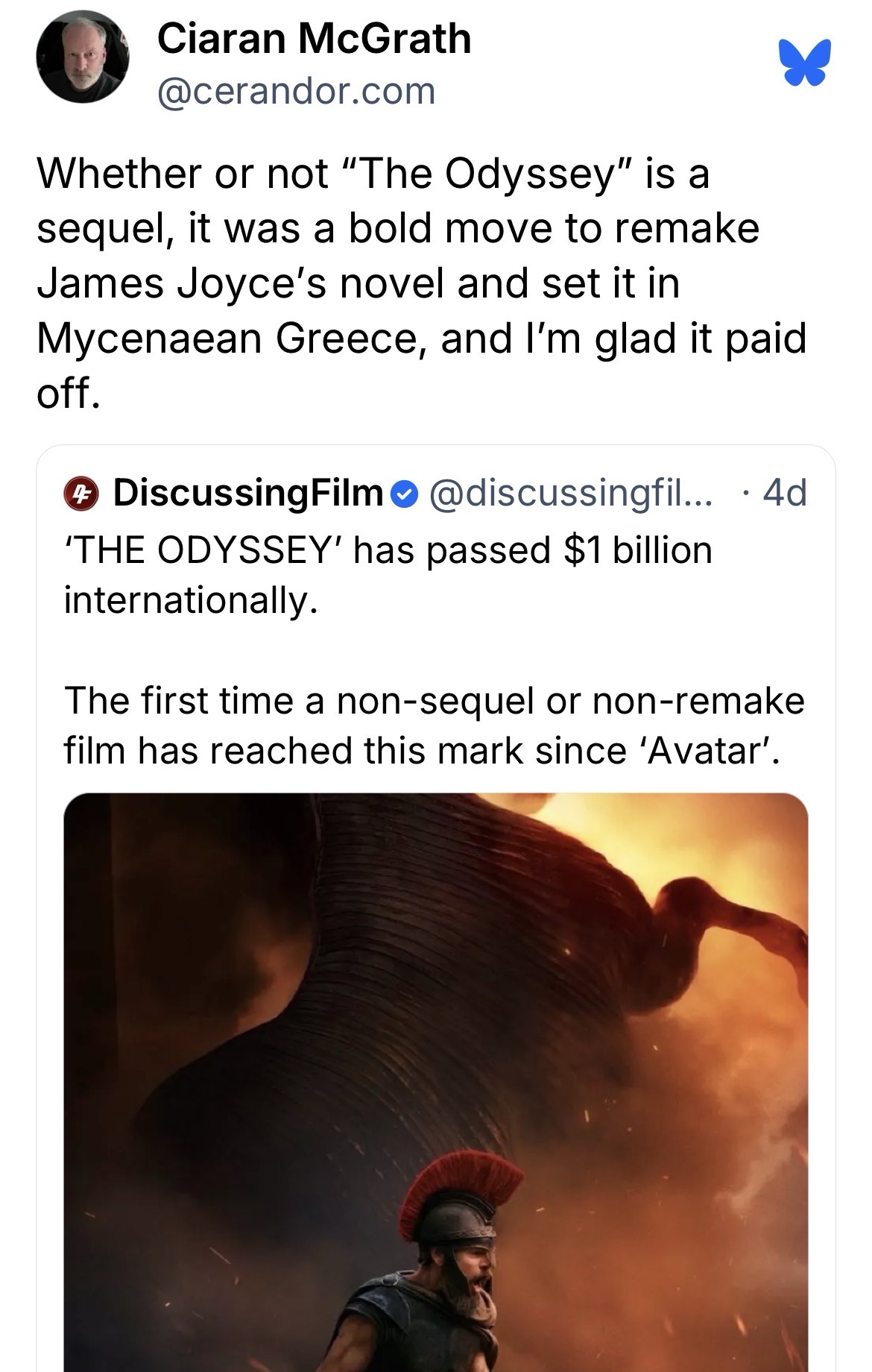
Bloom is himself a stranger in multiple ways:
- he is Jewish in a predominantly Catholic city
- he is an outsider to certain social circles
- he is emotionally isolated within his marriage
- he is a figure of suspicion, mockery and sometimes violence.
Yet Bloom repeatedly performs acts of hospitality: he feeds the hungry, cares for the injured, offers companionship and refuses to participate in certain forms of cruelty. His wandering is not only physical. We are postioned moral.
The novel’s famous “Ithaca” episode, in which Bloom returns home with Stephen, is structured around questions of food, drink, shelter and domestic ritual. The offering of cocoa, the arrangement of cups, the sharing of a modest meal and the careful attention to the needs of the guest echo the ancient pattern of xenia: welcome first, questions later.
Joyce therefore transforms the law of Zeus from a divine command into an everyday ethical practice. Hospitality becomes less about gods and more about how people treat one another in a city marked by poverty, nationalism, sectarianism and colonial power.
The Irish parallel is significant because it places Ulysses within a culture that already understood hospitality as more than personal kindness. Historical accounts of Brehon law and medieval Irish society describe obligations to provide food and lodging to travellers, including public hostels or bruidheanna for guests.
The phrase céad míle fáilte, a hundred thousand welcomes, carries a related cultural memory. But Joyce does not romanticise this tradition. He shows how hospitality can be withheld, distorted or made conditional.
Bloom’s experience reveals the limits of Irish welcome:
- he is excluded from certain forms of nationalist solidarity because of his Jewishness
- he is mocked for his accent, manners and identity
- he is subjected to casual antisemitism and xenophobia
- he is simultaneously insider and outsider, host and guest, Irish and other.
This makes Ulysses a more complicated meditation on hospitality than a simple celebration of Irish welcome. It asks what happens when the stranger is not a temporary visitor but a permanent resident who is never fully accepted.
Joyce’s Dublin is not Ithaca. It is a city in which the law of Zeus is tested not by monsters and suitors, but by everyday prejudice, economic insecurity and political tension. I think thats much more interesting then the heros journey.
Joyce’s novel implies that the future of a society depends less on its heroes than on its capacity to receive the stranger.
Bloom does not save Dublin. He survives it, in doing so he models a different kind of agency: one based on care, restraint and the willingness to remain present in a world that does not fully accept him.
On hospitality and extraction
Hospitality is not the same as unlimited access. A host welcomes a guest, but the guest does not acquire the house.
This distinction helps sharpen the ecological critique. The sea may carry the traveller, but it does not exist for the traveller. A landscape may host a film production, but it is not merely a location. A community may welcome a production, but it should not become an invisible service provider for another institution’s prestige.
Hospitality involves relationship, reciprocity and obligation. Extraction treats place as an input.
The film may invoke hospitality as an ethical principle while its industrial form remains closer to extraction. This is one of the films central contradictions.
The ecological imagination
The ecological issue is not only that the film uses ships, oceans and spectacular locations. It is that its imaginative structure can reinforce the idea that the world exists as a sequence of terrains available for heroic testing.
This use of our imagination and cultural infrastructure reinforces the baseline neo-liberal construct that the world, the natural wild world is merely for human use and extraction. Have we not moved beyond this? Clearly not.
So when a EPIC cinematic marvel main lines this narrative and spends $250m saying:
- the sea is a challenge for us to master
- islands are a temptation or threat
- animals are a resource or monster, although the magic and metaphor of transformation might be toyed with differently but only for a witch
- use the landscape as a backdrop
- others community is to be plundered to keep us going but our own on our return is our reward
- the household is the destination
The ecology is reinforced as a commodity: something to be captured, travelled through, photographed and converted into cultural value.
An ecological imagination would ask instead:
What relationships does the traveller enter, and what does their passage do to the places and beings that receive them?
The film’s material production introduces another layer. The use of real locations and analogue film may be understood as a defence of physical craft against a frictionless digital culture. But materiality is not the same as care. Real materials, real landscapes and real labour can still be organised extractively. What relationships did its material making honour, and what relationships did it consume?
This is where the film fails what our imaginations need right now.
Christopher Nolans film reveals that our imagination is still centralised, heroic and scale-dependent. We can imagine a man crossing oceans, surviving monsters and returning from war, but we struggle to imagine the ordinary, collective infrastructures that make survival and repair possible.
We need stories that help us imagine ecological reciprocity, sufficiency, regeneration and collective repair. The film gives us survival, danger and return, but not necessarily a vivid vision of how communities and ecosystems recover.
I am reading Ruha Benjamin’s, The Creativity Manifesto. She invites questions about how imagination is structured by power, technology and racial hierarchy. Technology can conceal and reproduce inequality while appearing neutral or benevolent. Liberatory imagination requires creating narratives and social arrangements beyond inherited domination.
She makes me really think rather than consume, I suppose that is how I like my culture. all of this ties back to my Futures work:
Who gets to imagine, and whose future is treated as credible?
- Old heroic imagination: a powerful individual confronts chaos, masters danger and returns to restore order. This is compatible with authoritarian politics because salvation depends on exceptional male leadership.
I am not represented in this world I am prepheral, it does not represent me nor how I am in the world. - my world an emerging relational imagination: no one survives alone; every return depends on care; places are inhabited rather than possessed; the future is made collectively; the dead and displaced remain part of the political community.
The film humanises the hero, questions the cost of war and makes return morally difficult. But it does not relinquish the heroic structure that gives the film its power.
Christopher Nolans film may succeed in giving us:
- a vivid experience of ancient myth
- a language for moral injury
- an anti-war meditation
- an emotionally legible account of return
- a spectacular cinematic event
But it may fail to give us the imaginative forms that the present today in the poly crisis and requires:
- how we in community repair after violence
- women’s agency changes the political order
- if strangers become neighbours
- places are cared for rather than conquered – economically, socially, ecologically
- how wealth is redistributed
- how ecological limits shape desire
- peace becomes ordinary and materially supported
- how a society might value sufficiency over spectacle.
In other words, it gives us an imaginative account of survival, but not necessarily of regeneration.
It gives us the hero’s return, but not a compelling account of what happens the morning after. The feast, the rebuilding, the redistribution of land, the care of the traumatised, the restoration of damaged ecosystems and the remaking of political relationships remain less dramatic.
Yet those are exactly the questions our moment requires.
Our social and ecological crisis is not asking us only to imagine surviving the storm. It is asking us to imagine a different relationship with the sea, the land, other species, labour and one another.
The disappointment is not that Nolan tells an old story. It is that, at this particular moment, he uses immense cultural and material resources to make the old story feel inevitable again.
written 24 August, it needs a stonger edit and attention to flow. But it is what it is and I am publishing this. I may write more on hospitality in light of changes to Irish Citizenship announced this week. END.


Leave a Reply