A public engagement project using deliberative technology to find shared understanding on digital infrastructure in Ireland.
Why this, why now?
As data centres expand across Ireland, public concern is growing. This pilot offers a new model for listening across perspectives and generating actionable insight—before decisions are locked in.
About the project
A structured, national-scale public dialogue using Pol.is to identify common ground in a complex policy landscape. This is a civic infrastructure experiment, not a campaign.
What we are doing
- Hosting a national Pol.is conversation on data centres
- Involving diverse voices: community, industry, youth, policy
- Delivering analysis and insight to inform decision-making
- Documenting a scalable model for future policy engagement
Support and collaborate
We are seeking €15,000 to launch this pilot and welcome supporters, advisors, and collaborators.
It you have any other projects or applications for Pol.is get in touch I’m actively looking for projects to test it.
Contact me, Roisin Markham, through the following form.


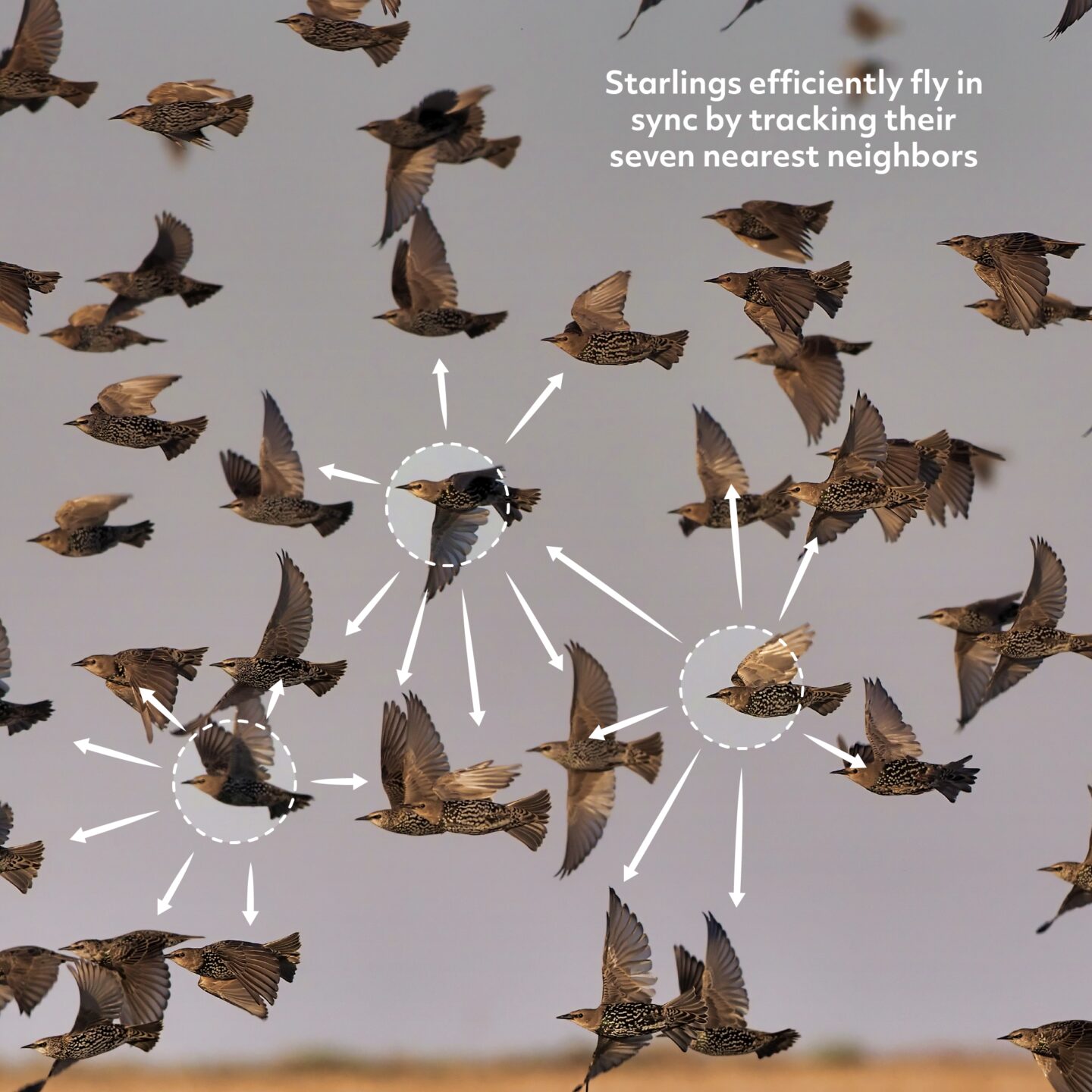
I’ve been looking at metaphors, ideas, graphics to put with this idea – murmuration’s and mycelium networks present themselves.
Murmuration’s in Ireland are sensational. Starlings stay together within a flock by paying attention to the movements of the seven other birds closest to it.
How might we use that principle in practicing democracy?
Curiously the Irish word for Starling is druid.
This text and image from Asknature.com I return to often:
A starling manages to stay within inches of other starlings, turning at high speeds, without ever colliding. They do this by paying close attention to the speed and direction of the seven other starlings closest to it. Any fewer, and there’s not enough reliable information for a starling to maintain flying with precision within the flock. Any more, and there’s too much information to process quickly and make real-time decisions.
The way starlings coordinate their behavior with an optimal amount of information has many lessons for people. We have to make decisions often with too much information at our fingertips. How much information is enough? Starlings remind us that there is a balance between having enough good information to make decisions, and learning to filter out the rest.
“More generally, our work demonstrates the significant role of who is interacting with whom in the ability of a network to efficiently manage uncertainty when seeking to maintain consensus. This suggests possibilities for understanding and evaluating uncertainty management in other social and technological networks.”
Young et al. 2013:6 & 2013:2
when uncertainty in sensing is present, interacting with six or seven neighbors optimizes the balance between group cohesiveness and individual effort.”
Patterns of social insects self organising enables a swarm (think ants, bees) to carry out complex tasks through the collective duties of individuals within the colony without being centrally controlled. The collective effort of the whole group is the only means by which the group is able to sustain itself and grow as a community.
The negative patterns of swarming of locust may also have rich metaphor to tackle non-democratic approaches, influence of louder voices, social media algorithms.
It is the balance of information, trust, discourse not competition to find the shared ground that is important. I believe we need more conversations locally, technology can support that scale.
I am aiming this pilot be tested with 200-300 people.
The flight patterns of birds by Dennis Hlynsky and Xavi Bou’s Orthographies offer rich visual complexity. In part I see a reflection of this work in my own 2014 work on abstracted writing, which in itself was an unlearning of writing, like lifting a thread of the page. I’ll have to go to my archives to see if I have any images.
Further thoughts
Official Pol.is Website:
- https://pol.is/ (for people to explore the tool itself)
- https://pol.is/docs/ (for more technical deep dives, but good to know it’s there)
Last updated 22:00, 12 June 2025.
 Roisin Markham