
What if we designed a future where “public voice” wasn’t just a phrase, but a living, breathing component of our land?My work towards the ‘Shared Ground’ pilot and ‘Democracy as Murmuration‘ isn’t just about wishing for better conversations; it’s about building the practical pathways to them. Part of this vision is a powerful, yet surprisingly simple, tool that I believe our government, and indeed our entire nation, should embrace: Pol.is.
Do you remember the feeling. A policy is made, planning permission granted, another poll drops, painting a broad brushstroke of public opinion, often missing the nuanced texture of what you really think and feel.
We’re told our voice matters, but in practice, engaging in our democracy can feel distant, abstract, or limited to a tick-box exercise. If we want to live in a democracy we have to practice it and have good strong social infrastructure to support it. For a country as vibrant, opinionated, and community-driven as Ireland, shouldn’t our civic conversations be just as dynamic, inclusive, and truly representative?
What is Pol.is? And Why I’m Championing It for Ireland
Imagine if, instead of relying on traditional polls that often capture sentiment but miss the why – or the broad strokes of a Red C poll – our public bodies could engage citizens in a way that surfaces common ground, understands nuance, and truly builds a shared understanding. That’s the profound promise of Pol.is. It’s not just a survey tool; it’s a collective intelligence platform designed to empower people to actively contribute to policy and public life.
Its already been proved to work, its tried and tested tech:
Imagine Pol.is tackling the complexities of our housing crisis, not just through expert panels, but by mapping collective consensus on sustainable solutions…
Think of it like an online forum, but with a clever, democratic twist, that we badly need, it cuts out the noise and focuses on shared understanding:
- You propose statements: Anyone can add an opinion or idea on the topic at hand.
- You vote on other people’s statements: You simply choose “Agree,” “Disagree,” or “Pass” on each statement you see.
- No direct replies or arguments: This is the game-changer. You don’t get into a back-and-forth debate with individuals. Your vote contributes to the collective picture. This means you can’t be shouted down, and everyone’s input carries equal weight in shaping the overall understanding.
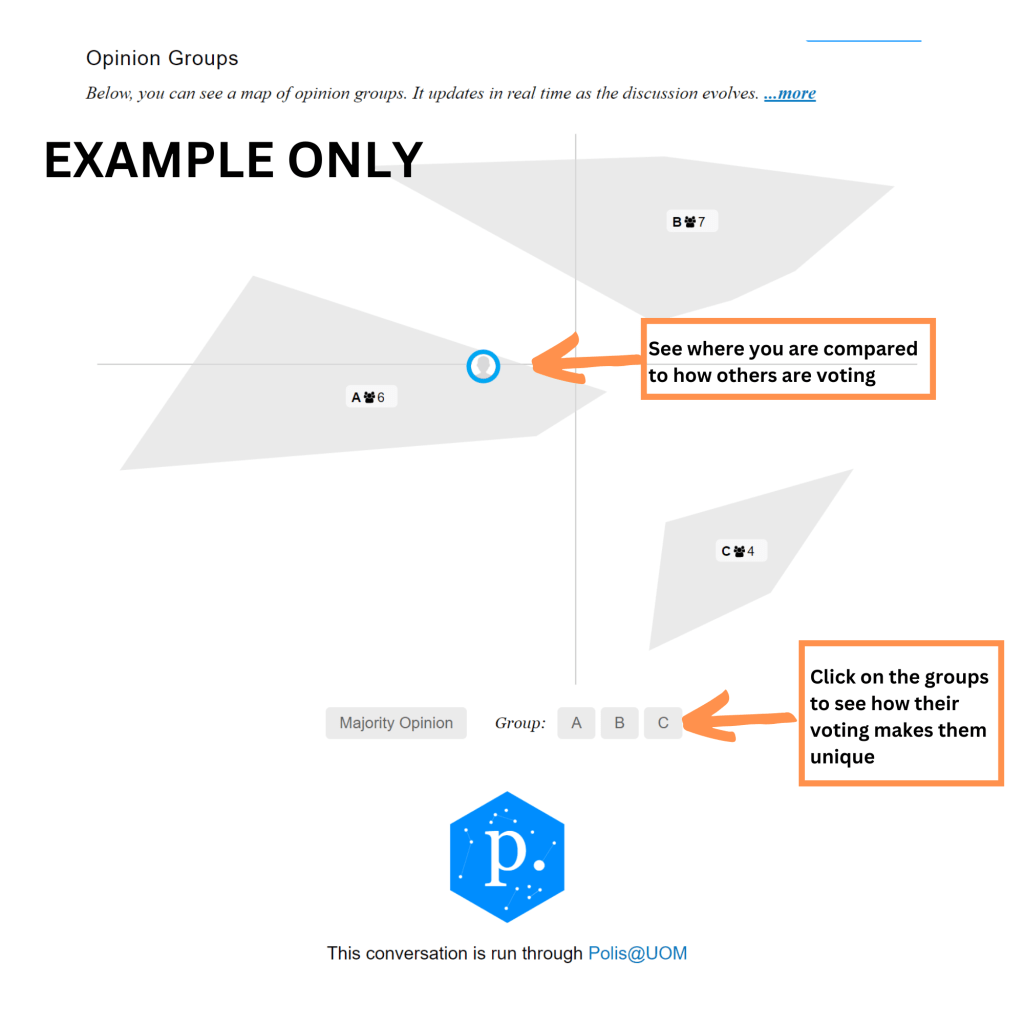
- It shows you where everyone stands: Pol.is uses a smart bit of technology (think of it like a very clever cartographer for ideas) to visually map out who agrees with whom, where the major points of consensus are, and where opinions genuinely diverge. You see clusters of similar viewpoints and the statements that bridge different groups.
This is why I’m not just advocating for Pol.is as a tool for individual groups; I’m championing it as a foundational shift for how Ireland engages with its citizens. I envision Pol.is as the successor to outdated polling methods, offering a richer, more democratic, and genuinely inclusive way for the Irish people to directly contribute to policy and public life. It’s about empowering our nation to truly activate its public voice and reshape what living in a democracy means for every person in our land.
Imagine Pol.is tackling the complexities of our data center planning, not just through expert panels and oppositional views, but by mapping collective consensus on sustainable solutions…
Navigating the Nuance: Addressing Common Questions and Considerations
Of course, with any new approach, especially one that aims for national adoption, legitimate questions and considerations arise. Look lets walk before we can crawl. I want to continue sharing information about this approach and I’m at early days, that is why I want to run a Pilot first before going full steam ahead with it. Maybe we should change ‘full steam ahead’ to a more clean energy full solar charged!
So what are your concerns? If I don’t address them here, reach out to me and lets talk about them.
The Data Commons: “Who owns this information? Is it safe?”
This is a big one, and rightly so. As someone who’s probably the most data-sharing-adverse nerd you know, I understand the inherent caution. When we talk about collective data, especially at a national scale, questions of ownership and use are paramount. The ‘Shared Ground’ pilot isn’t just exploring Pol.is as a tool; it’s exploring the profound idea: What if the collective insights from these national conversations were a true commons, owned by the Irish people living and working in this democracy?
This vision is about building a civic listening field – a treasure trove of nuanced public understanding – that belongs to all of us. It’s not about tracking individual opinions, but about understanding the collective pulse of the nation, respecting privacy by design, and using these insights as a public resource to inform policy, foster greater trust, and build a more responsive and genuinely democratic Ireland. This data isn’t a commodity; it’s the shared wisdom of our people. The pilot will let me research if that’s possible and how we can hold it in trust. Can that data become a new form of social and civic capital, a democratic currency? Can we ask more of technology, no let’s demand more of it?
Message Dilution & Control: “Will this lead to chaos or dilute national focus?”
A valid concern. Government communications and policy objectives are carefully crafted. The fear might be that an open platform could introduce irrelevant or even harmful noise. The key here is careful setup and light-touch moderation. The bodies hosting these national Pol.is conversations would set the initial prompt and guidelines, and statements that are clearly off-topic, offensive, or break established rules could be removed. It’s not about letting chaos reign; it’s about cultivating a structured and inclusive national conversation space, facilitating broad input without sacrificing focus.
It will be important to build on Ireland’s strong reputation for deliberative democracy. I am not suggesting replacing Citizen Assemblies, but how can 100-80 people represent all of Ireland and their views? This is a YES AND above all else.
Digital Access & Inclusivity: “Is this really accessible for all citizens, especially those offline?”
Absolutely crucial. While Pol.is is relatively simple to use, it does require internet access and a certain level of digital literacy. For Pol.is to truly serve as a national tool, it must be paired with robust offline engagement. This means strategic outreach through community centers, libraries, local councils, and public events where people can participate in Pol.is conversations with assistance, or through parallel offline methods. The goal is inclusive national participation, ensuring we embrace multiple formats and access points, so no voice is left behind due to a digital divide.
This is a deeper dive demo video if you are ready for it and interested:
Imagine Pol.is tackling the complexities of our Just Transition, not just through expert panels, but by mapping collective consensus on sustainable solutions…
Learning Curve & Capacity: “Won’t this just be another burden for government bodies?”
I have no idea lets test it – what it it saved money and time? and strengthened our institutions? Introducing new systems can feel overwhelming for any large organisation, including government departments. But the beauty of Pol.is, once past its initial setup, lies in its simplicity for participants and its powerful output for analysts. While there’s an initial learning curve for implementation and insight generation, the long-term gain is immense.
Consider this: it’s not just an expense, it’s a strategic investment in more effective, evidence-based governance. It’s about reducing the guesswork and the “burnout” that comes from constantly trying to second-guess public sentiment or react to narrow viewpoints. Instead of working harder, we work smarter, more precisely, and with greater public trust, ultimately serving the Irish people better. Crucially, this initial time spent in learning can be supported through dedicated pilot programmes, peer-to-peer learning, and a commitment to shared expertise across departments, ensuring that the burden is manageable and the benefits are quickly realised.
Next I’ll aim to do a bit of a critical analysis and explore risk, benefits and the risk of doing nothing to strengthen our democracy.
Further reading:
A Canadian use case and lessons learnt; Pol.is, Official Languages and a Shift Towards ‘People-First’ Policy Development.
 Roisin Markham
Leave a comment