
I live with questions. The question I have been living with for the last five years is changing. I knew it would move this year, I was certain of it. Since 2020 I’ve been living with…
How do we create a future worth living into?
how might we, it’s been quite the journey. I’m sensing into the evolving, transmogrifying, question and along the way working towards
How might we create an Ireland worth living in?
covering
- how might we create a flourishing Irish society within planetary boundaries?
- what is the experience of that Ireland? what does it feel like to live there?
- what is the vision for Ireland in 2050? in a changed world at 2 degrees hot
- what if we put care at the center of that vision?
- what are the values for a future Ireland?
- if we pull Irish society into the thriving space within the planetary boundaries where no one falls short of what they need to live a good life what does that look like?
If we accept that our economies only exist within society then we should be tending to the society. Our society. It’s in crisis.
At the Recent Rethinking Growth Conference in TCD, Paschal Donohoe Ireland’s Minister for Public Reform and Expenditure was eloquent, smart. Expressing very clearly that he believes we cannot have the economy we want without growth. I’d like to see that positioned challenged in Ireland and a robust debate public debate on it.
I also think it’s useful to have a view of the global trends informing us of risk, I will write about them in more depth in another post. The following are my views of imminent global within a now +5-year window and and national trends now – +8year.
Global trends impacting Ireland:
- Climate change
- Geopolitical landscape, rise of populism and extremism
- Increased displacement and forced migration due to war and climate impact
National trends:
- Social cohesion – active democracy, populism and extremism,
- Housing crisis – traumatising a whole new generation of people around a place to call our own, a home, a roof over our heads, somewhere to feel safe
- Healthcare and health services access to timely and appropriate healthcare, with rural communities and young people in a postcode lottery
- Energy and transport poverty increasing – more recent research indicating a “core” energy poverty rate of around 17.5% ESRI, Irish Energy Poverty Action Plan, with a potential rise to 43% if energy prices continue to climb.
- Decreased biodiversity – more than half of Irish native plants are in decline, 63% of bird species in Ireland are in decline (UCC 2023)
- Climate change impacting weather patterns, water, agriculture, health and sea level rise
- Disruptive technology – AI, cyber security, data and data storage.
With the stark reality that human activity on the planet is not letting nature regenerate itself, our negative impact on the planet means out of nine life sustaining boundaries we have transgressed 6.
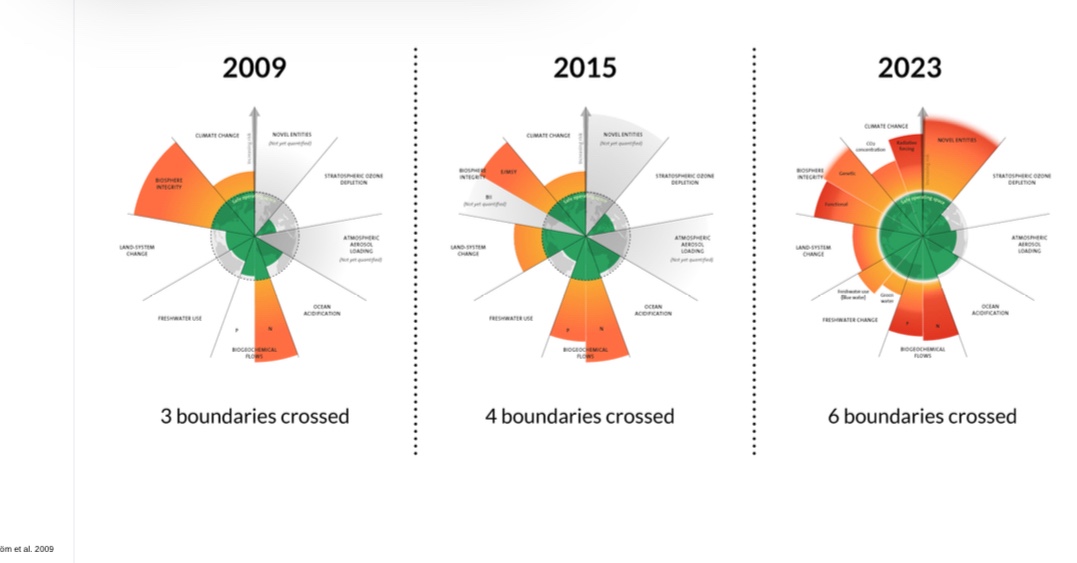
The 6 boundaries are Climate change, biodiversity loss, nitrogen and phosphorus loading, land-systems change, ocean acidification, phosphorus depletion. Their transgression means:
- Climate Change: Rising global temperatures due to greenhouse gas emissions are pushing us closer to a tipping point, leading to more extreme weather events, rising sea levels, and melting glaciers.
- Biodiversity Loss: The variety of life on Earth – plants, animals, insects – is crucial for healthy ecosystems. However, deforestation, pollution, and climate change are causing a mass extinction event, disrupting the delicate web of life that sustains us all.
- Nitrogen and Phosphorus Loading: These elements are essential for life, but human activities like fertilizer use have caused an overload in our water systems. This disrupts ecosystems by fueling harmful algal blooms, depleting oxygen, and creating dead zones.
- Land-System Change: Forests are being cleared at an alarming rate to make way for agriculture and development. This not only destroys valuable habitats, but also disrupts natural water cycles and contributes to climate change.
- Ocean Acidification: As oceans absorb more carbon dioxide from the atmosphere, they become more acidic. This harms marine life, particularly organisms that build shells from calcium carbonate. Coral reefs, crucial for marine biodiversity, are particularly vulnerable.
- Phosphorus Depletion: While excessive phosphorus is a problem, the other side of the coin is depletion. Phosphorus is a finite resource, essential for fertilizer production. Overuse could lead to future food shortages.
These six transgressed boundaries are a stark warning. We’ve been pushing Earth’s systems to their limits, jeopardizing the very foundation that sustains life on this planet. Understanding these boundaries and the consequences of exceeding them is crucial for taking action and finding a more sustainable way forward.
So in framing how we might consider a future Ireland it has to address pulling our society within plantary boundaries. We cannot solve the housing crisis in business as usual its impacts will have consequences for future generations.
So in solving the crisis of our times we give
- 30% for wild nature, every where just hand that back to nature – anyone who owns, stewards or creates human activity in urban or rural spaces gives 30% back to nature right no.
- do no harm – not solving current crisis creating downstream, future ancestor crisis, within planetary limits,
According to 2022 CSO data, Ireland has a 62% Urban – 38% Rural split can our policies, public consultations reflect that. Same with our new locals which now consist of a 23.5% different identities and cultures (includes 0.7% Traveller)
- in a changed future where the earths self correcting systems alter our current patterns of human activity how will we hold strong and be resilient?
- would an Irish society feel with real values like care, wellbeing (well being economy talks to dignity, fairness, participation, nature and purpose)
In the most recent research run by advertising industries Purpose Disruptors they asked some of these questions, Understanding Ireland CITIZEN VISIONS of a Good Life in 2030. A recipient of the Creative Climate Action fund, an initiative from the Creative Ireland Programme. It is funded by the Department of Tourism, Culture, Arts, Gaeltacht, Sport and Media in collaboration with the Department of the Environment, Climate and Communications. The fund supports creative, cultural and artistic projects that build awareness around climate change and empower citizens to make meaningful behavioural transformations.
The research is based on
- a deep dive with 25 citizens were selected based on
CAO data to be Nationally Representative of the Republic of Ireland adult population – across all four provinces - sample questions from IPSOS B&A’s online barometer from 23rd Nov-4th December 2023, interviewed a nationally representative sample of n=1,030/3,945,000 adults aged 16+
If we take this research as representative this summary and a deeper dive into the report is worth considering.
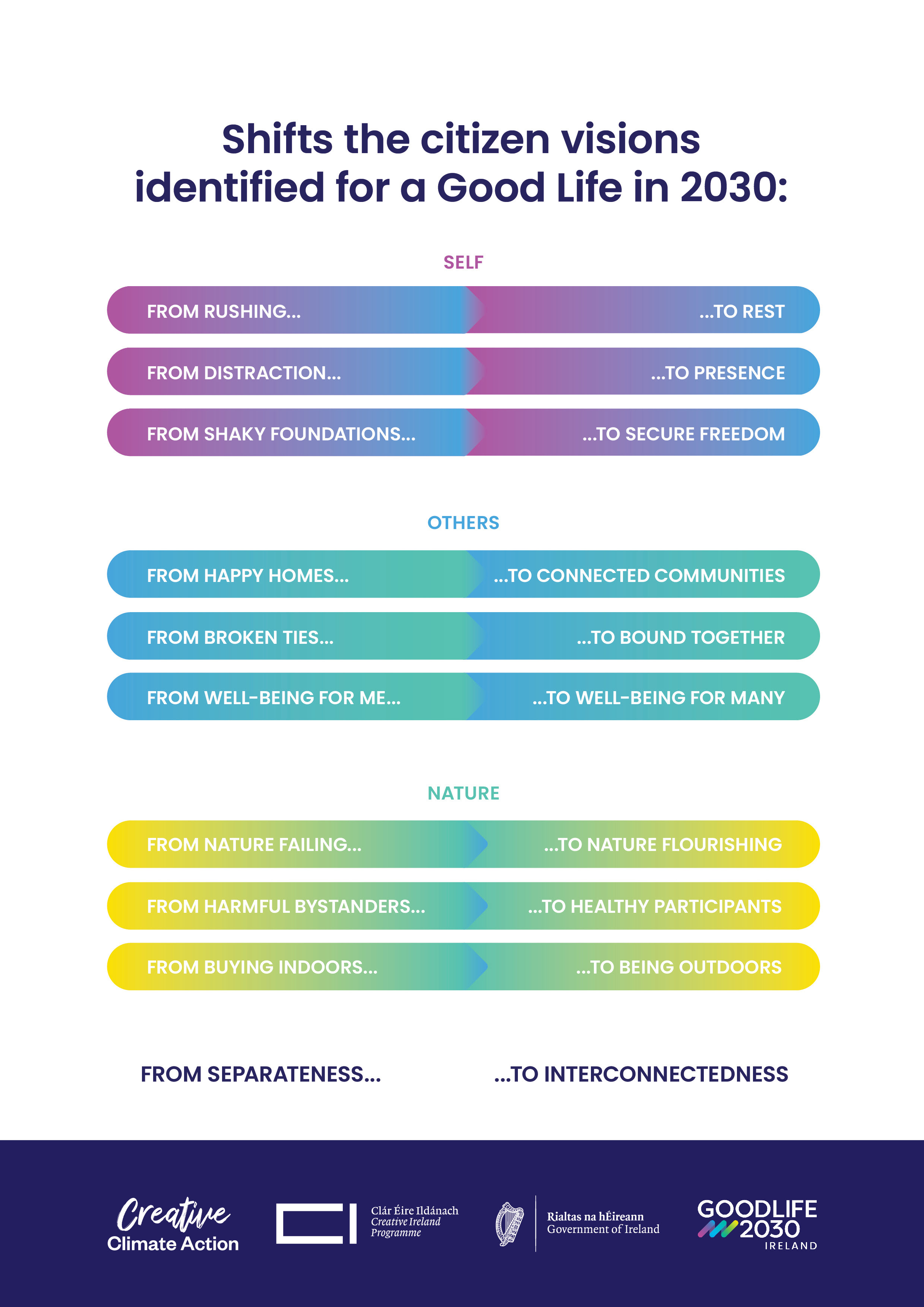
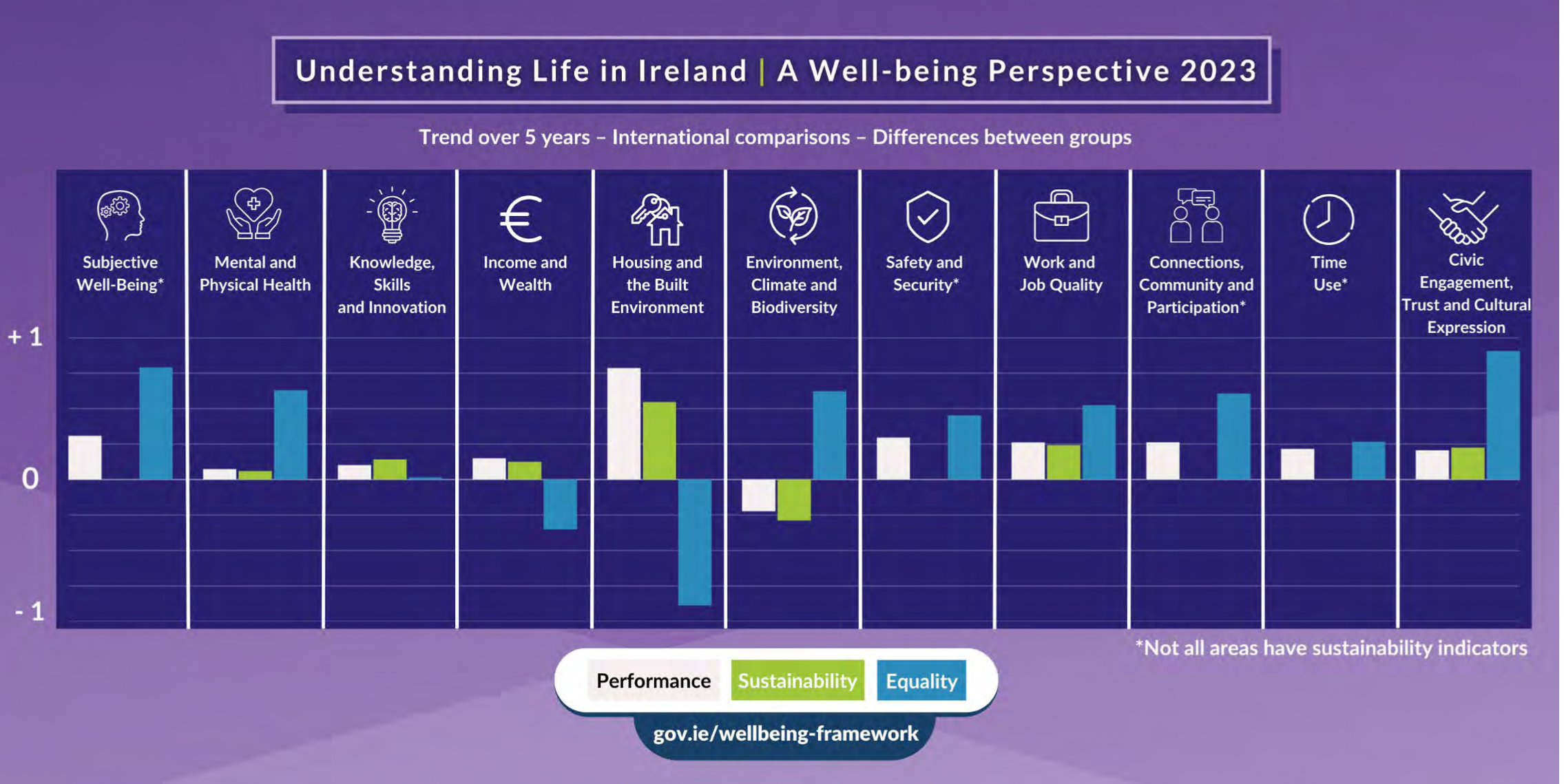
It’s interesting this research did not take into account or draw any correlation from the governments, Understanding Life in Ireland, The well-being Framework 2023.
I want to put other kinds of value systems and measurements into our field of action in Ireland, think tanks like Dark Matter Labs and Doughnut Economics Action Lab. Ideas and a broader view of what we should be measuring for a thriving society, I am inspired by the work of Regenerative Melbourne, Ladywood Birmingham and the Cornerstone indicators.
So I’m asking people I know – what do you care about?
I continue to push at the edges of these questions, of my own inquiry. Of how to apply doughnut economics and systems change. Harnessing practical action and change. I recognise we have to have multiple points of entry and leadership has to come with a strong vision created through democratic process.
What are we currently measuring, CSO key economic dashboards across three themes macroeconomics, business and people:
- Real GDP, Real GNP, General Government Balance, Gross General Government Debt, Personal Consumption Expenditure, Net Expenditure by Government on Goods and Services, Gross Domestic Fixed Capital Formations, Total Exports, Total Imports, Modified Final Domestic Demand, Balance of Payments Current Account, CPI (Consumer price index), Household Savings Ratio
- New Dwelling Completions, Export of Goods, Import of Goods, Manufacturing Industries Producer Price Index, ~Road Freight Carried
- Employed, monthly unemployment, live register, average weekly earnings, residential property price index, new private cars licensed
This is definitely the measurement of an economy not a society. As we move through 2024, towards 2030 and the Paris Accord we need to ensure Ireland, our society and we are valuing the right things. Lets invest now in vision, values, infrastructure and services we need to create a thriving society living in plantary boundaries.
Mary Robinson in her keynote address at the DCU Centre for Climate and Society 2024 conference said
“at the moment and I think we really have to incentivize heavily to move in the right direction more, and you know I sometimes feel that we need to spend our children’s and our grandchildren’s money more now or our children and grandchildren won’t have the future they want you know it’s a simple as that so we need to get much more incentives much more focus on what does it take you to move now into a different way of doing and we all need to change our behaviour”.
Mary Robinson, “Climate Justice Across Generations”, on 16 April 2024
We need change. Policy is key, it has to come top down at policy, industry, education and grassroots up from civic society.
In Deirdre O’Mahony’s recent film, The Gathering exhibited in Douglas Hyde, TCD and toured in six rural locations in the south east of Ireland. Deirdre created amazing librettos. This one in particular haunts me
“Nature shrinks as capital grows“
The Gathering, Deirdre O’Mahony 2024
The librettos, sound track was created from conversations over slow food, at exhibitions and collective gatherings, recordings deep in the soil of Wexford and Kilkenny with dung beetles and earthworms. As all good art should it challenges… How do we increase nature?
How do increase biodiversity and still have livelihoods? How do we live well in a society at 2 degrees hot. A systemic change, a fundamental move in how we live and do business is required.
I wonder can we create an Irish Society that is worth living in, within planetary boundaries – a resilient place of care, community, restoration of nature, equity and the commons are regenerative.
Let me know – whats important to you, simply at a basic level.
What do you care about?

 Roisin Markham
Leave a comment