The arrogance at having something to say, of words to use has kept me from writing often. It also keeps me from sharing visual work and research. I’ve undermine and sabotaged years of perfectly good work: writing, painting, photography and social media. I tell myself I’ve not yet found my style or visual form yet. But the truth is I don’t consider what I share to be good enough. It does not represent the vision or ambition of where I imagine myself expression to be.

In choosing my word of the year, PRESENT, it is also a word that allows me to be exactly where I am. I’ve decided that it is good enough right now. So my visual style, my thinking and writing is what it is. Hate it, love it: the spectrums of responses are just that.
The idea of a ‘good enough parent’ which was shared with me when I was in crisis in 2015 is a definite influence here. Donald Winnicott a psychoanalyst first introduced the concept in the 1950s.
The “good enough parent” does not have to be perfect in order to be a good parent; rather, they simply need to be “good enough” in providing their child with the basic necessities of life, such as food, shelter, and safety, as well as emotional support and a sense of security.
Listening to Brené Brown, Unlocking Us last two podcasts on Living Big she talks about “are people doing their best?” wow she gets her knickers in a knot over that one and researches her way out of it. As a researcher on shame she speaks to vulnerability, so her work interests me.
When we relate these ideas to the inner critic, which is the part of our mind that evaluates and judges our thoughts and actions. Just like how a parent does not have to be perfect to be a good parent, we do not have to be perfect to be creative or have good ideas. Instead of striving for perfection, the good enough parent approach encourages us to accept and embrace our limitations and imperfections, and to focus on the process of creating rather than the end result.
In terms of creativity, this approach can be applied to the inner critic, which is the part of our psyche that evaluates and judges our creative ideas and abilities. Instead of striving for perfection, which can lead to self-doubt and creative blocks, this approach encourages us to accept and embrace our limitations and imperfections, and to focus on the process of creating rather than the end result.
By adopting the good enough parent approach, we can be more accepting of our inner critic and not be too hard on ourselves. We can allow ourselves to do our best in that moment.
Recently I rewatched Steve Chapman’s ‘This talk is n’t very good. Dancing with my inner critic’. It’s fairly brilliant. I admire the way he has crafted a dialogue with his inner voice, gotten to know its dark patterns and shadow plays. I love his creative process, intelligence, interrogation to unmask, make, shape and harness puppetry and performance art with humour.
I’m suggesting that adopting this attitude to our lives can offer us better mental health and a way to manage self criticism and self doubt. Framing this approach with befriending my inner critic, in practice what does that look like?
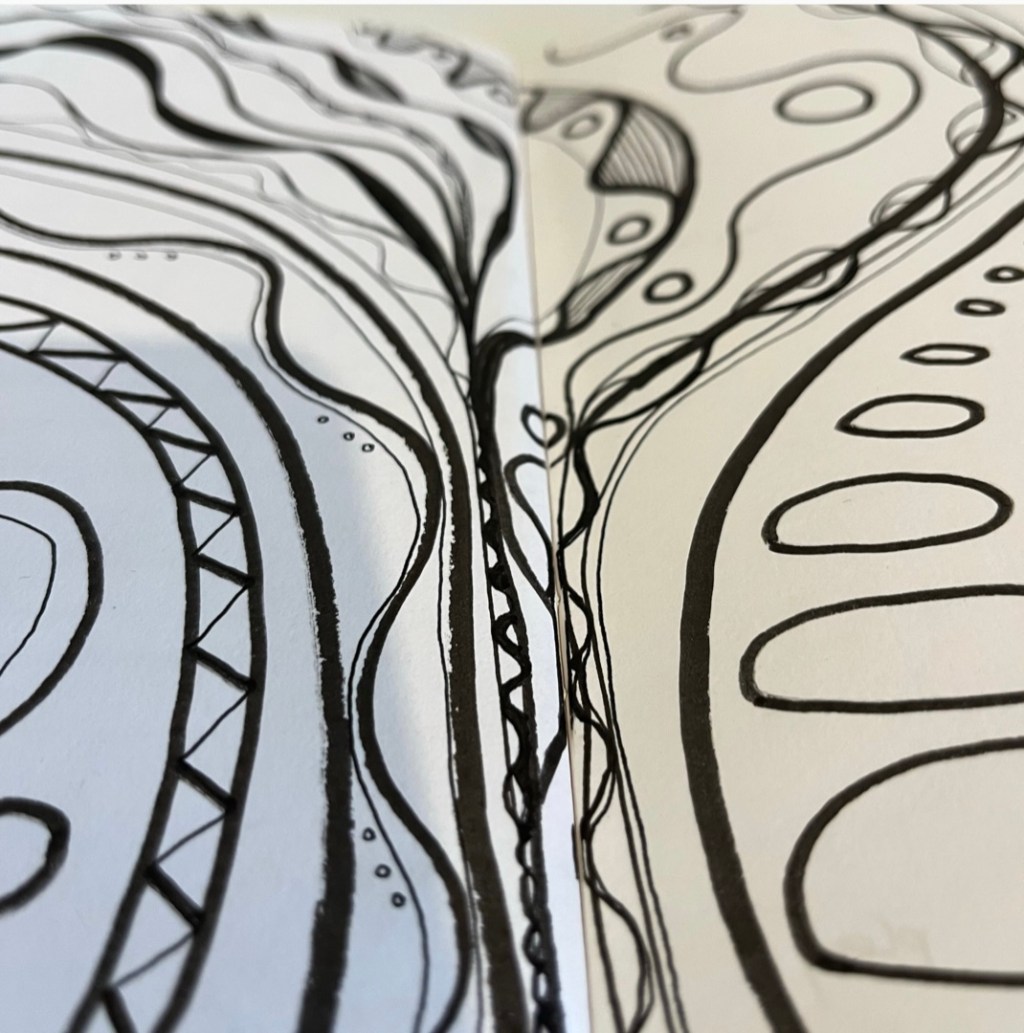
This year I’ve reestablished and changed up my morning practice. I’ve stopped writing words. I’ve started a doodle first thing everyday. Even before I’ve had a coffee, before I hear the news or check my phone. Sometimes there are words but mostly not. It’s freeing. I am combing this with a presencing meditation. I started with just 5 minutes and this week the doodling has grown to 30 minutes. I don’t restrict or try to expand it, that’s part of the creative flow I’m dancing with.
The hypotheses I’m testing is freeing myself up and ultimately leading to greater creativity and less self-doubt.
I am stretching myself gently. Leaning into doing the best I can, I am a good enough artist.
So what did the * mean for you?
 Roisin Markham
Leave a comment