As part of the BT Young Scientists 2020 I attended the free industry event before the launch of the exhibition opening on the 8th of January.
A rather excellent offering with good speakers, a heady mix of science, innovation and brilliant business men.

Brian Cox as the keynote offered us a perspective on our place in the world. A mind boggling expansive explanation of cosmology and scale. My take away from his talk was that despite our insignificance in the vastness of space Earth is the only planet know to support conscious life. Humans bring a consciousness to all things this is a weighty responsibility that we must use wisely.
In the Q&A session he Spoke about frontier advantage for the human race.
The challenge is the value – Mars space exploration early pioneer. Having someone at the frontier is better for humanity.
Collaboration for difficult problems unites countries around the globe.
Then in answer to the question “what advice would you give your younger self” he gave a Spacetrek episode example. The one where Captain is asked the same question and is given the opportunity to go back and change the past. In doing so he changes the future and does not become Captain of the enterprise. “Your mistakes make you who you are”. This is a very profound point for me.
The other thing he said was “go do the thing you want to do don’t worry about a job”. A very significant comment considering the audience that the BTYS serves.
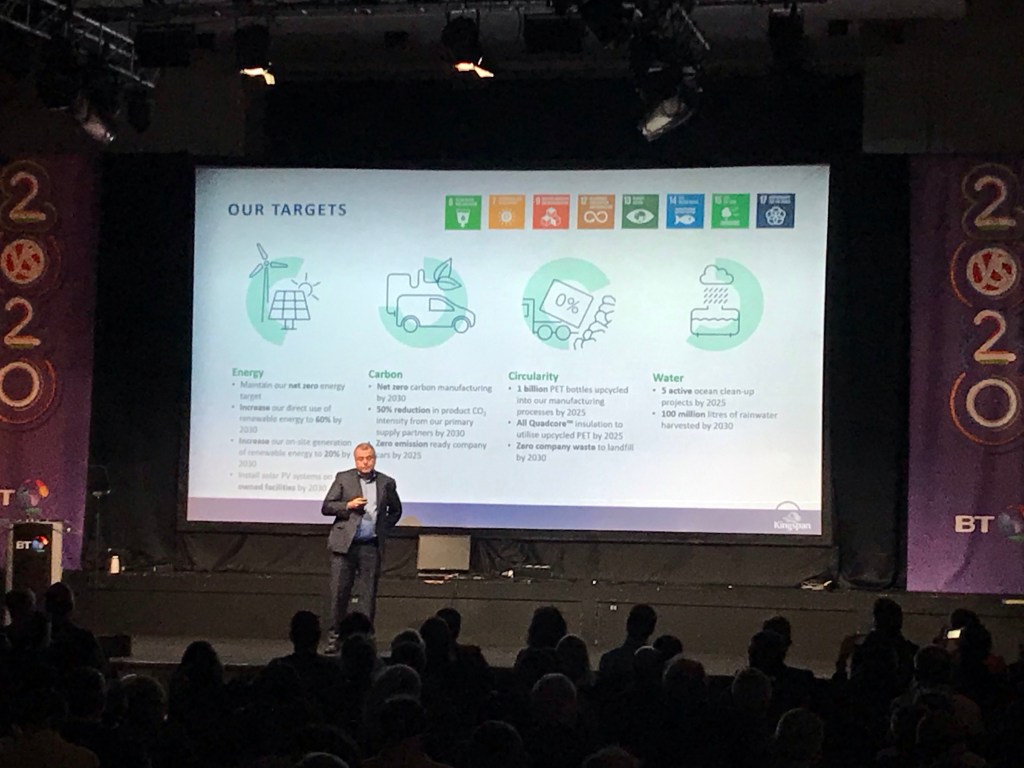
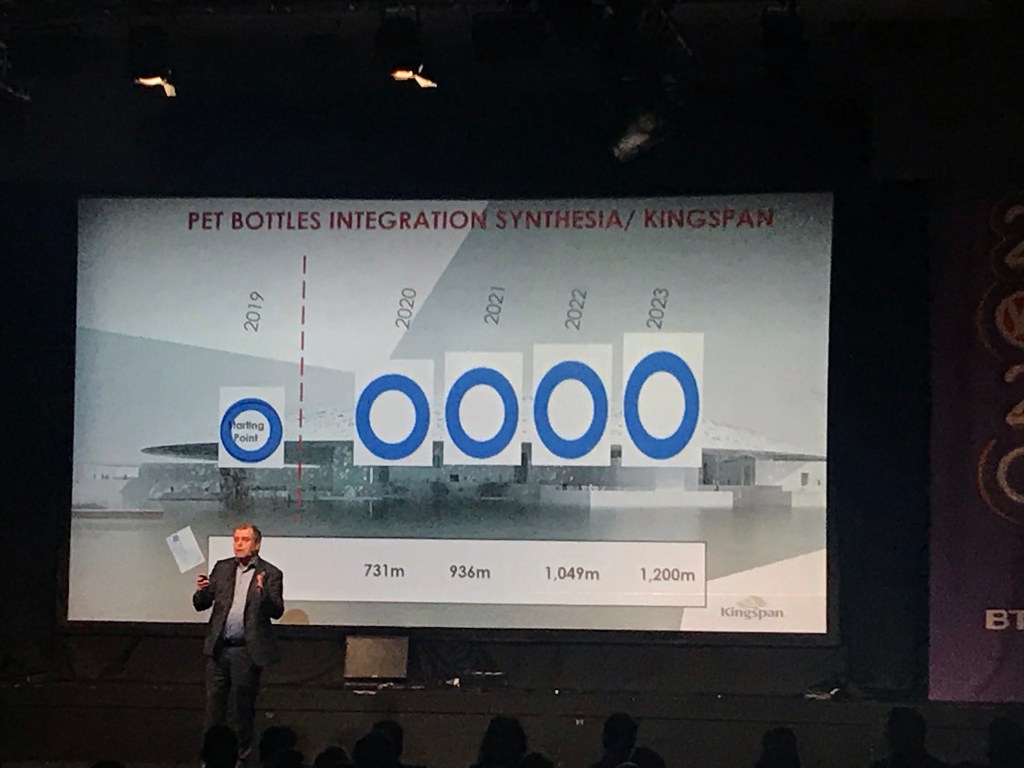
Mike Stenson, Head of Innovation at Kingspan was the first speaker his talk entitled Plastic Fantastic started in a very corporate pitch. Despite its shocking name it was interesting but smacked a little of a desperate attempt to greenwash the plastic sector. He discussed raw materials, resources in production cycles and the move to a circular economy, waste as a resource and ocean recovery.
It was excellent to see the UN Global Sustainable Goals being used on a corporate communication slide deck in such a strategic way. We need to see more organisations aligning and using the SDGs as a strategic and governance tools.
Mike showcased IKON Kingspans global innovation Centre in Ireland that has been built as a net zero carbon building. It’s piqued my interest I’d like to visit.
“So I think the solutions to this in terms of this whole plastic issue rests in terms of science and technology. And some of the questions again, technically that we have to ask is if it can all pass to be reengineered back to the previous level. So how was it made, can we reverse that kind of all the way back to, you know, molecular clusters on the carbon and hydrogen atoms, for example, kind of go all the way back to make a profit and for example, take, you know, a really terrible plastic bag and made a high performing potential revolutionary material in the future.”
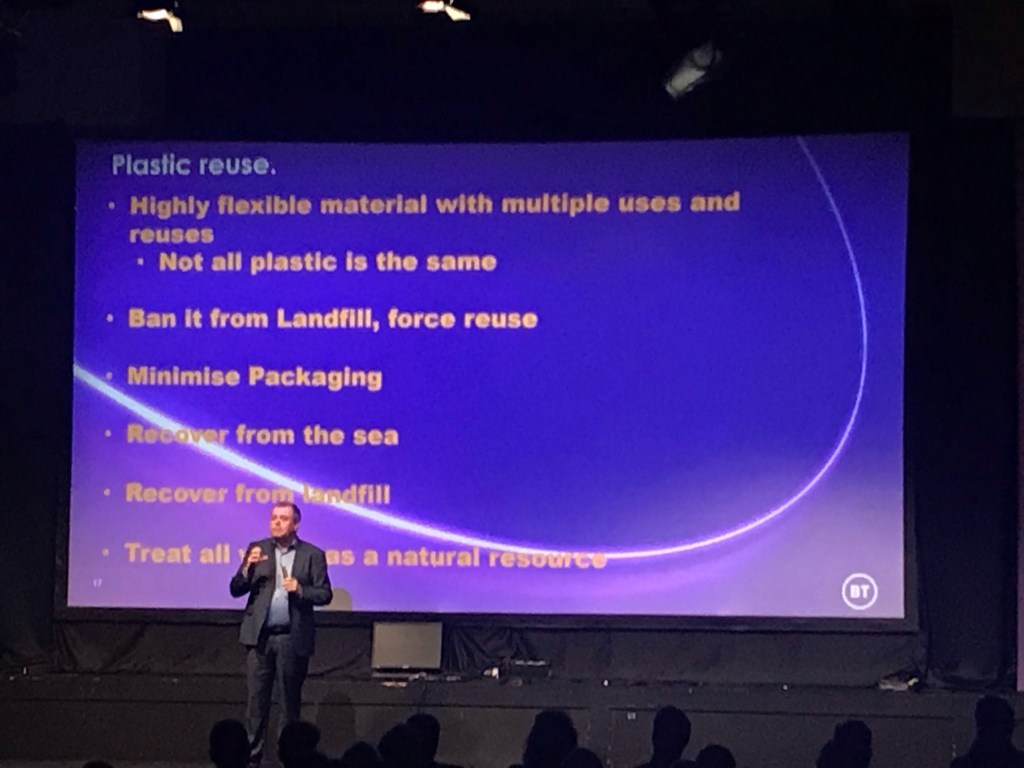
The second speaker was Gabrielle Giner, Director of Environmental Sustainability, BT Net zero by 2045?
She spoke of BT’s efforts to move to alternative sources of energy away from fossil fuels and to maximize energy efficiency. Her talk was very corporate, a few uninspired visuals that just had me zoned out. I should have paid more attention but I could n’t. My takeaway from her talk
“Big systems change overwhelm us and we don’t know where to start”
The third speaker blew me away completely.
Conor McGann, Senior Director of Software and Data, Plenty.
I recorded Conor’s talk with Otter.io from which I’ve only made minor edits. if you’d like to listen to the transcript click here. This was recorded on my iPhone for personal reference.
He spoke about his experience and journey to Plenty. Astonishing is the only way to describe it from Trinity College Dublin, an undergrad in Computer Engineering plus a PhD in artificial intelligence then AI start ups till 2003 to NASA with the autonomous systems research group his first mission was the Mars Rover Program. He moved to the Monterey Bay Aquarium Research Institute autonomy team in 2007 Which specializes in underwater ocean exploration.
A theme in his career moves was friends or people he knew reached out to him and asked him to join their team and a smattering of startups, research teams building autonomous systems capable doing very specific tasks using AI, adaptive science to solve task planning on board a robot, and solving the required objectives flexibly.
In 2011 he joined a big data machine learning bandwagon as CTO and co-founder they were focusing on interpreting unstructured textual data and in customer interactions eg. on social media. Using that information For generating insights and controlling actions. The use case was focused on the customer experience optimization with rich data in real time.
Conor emphasized In this particular case, He learned a lot about large scale data processing systems, integrating those in real time and connecting them to process optimization. This is what brought him to Plenty. Lots of AI experience but newbie to agriculture.

Conor’s talk and slide deck were excellent and compelling. Linking me into the Future of Food work I was doing with Bord Bia before Christmas and some on going research.

Data from USDA it’s comparing recommended daily average servings with the amount of production available in the world today. For example, the recommended daily average serving of sugar is none. But we’re producing a lot of it, you can see here that basically we’re over producing or meeting the current leads in sugars in fats and in grains and however we are under producing in nutrients and proteins fruits and veggies and proteins. This is for the current population never-mind future levels expected to grow in the next 20 years. So this is a big problem. We have to boost production and change our consumption habits to address it. Now this is problematic, because produce is fussy about where it grows. The majority of produce grown in the world was in a few hot spots, generally they have a natural Mediterranean climate, it’s very limited land available. So for example to put this in perspective. We estimate that we need about 300 million more hectares of land to meet the need, and which is about 10 times the size of California, and about 57 times the island farmed, that’s a lot of land.

And then there’s not land that’s available in these prime locations. Another critical problem with the agricultural system being able to meet this need is water scarcity in these Mediterranean climates we’re already hitting water limits, for example in California.
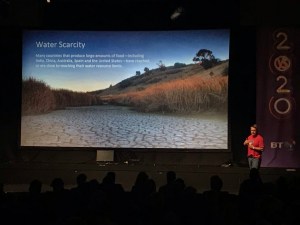
We’ve been irrigating our crops pumping from aquifers that have taken thousands of years to fill. And they are being heavily depleted, with climate change we see more and more drought, we see crop losses according to that coming from that.water scarcity is a huge problem.
the core food production is distributed all around the world. And this creates a very very complicated supply chain.
This is a rendering of the flow of goods from these Mediterranean and climates into their target markets.
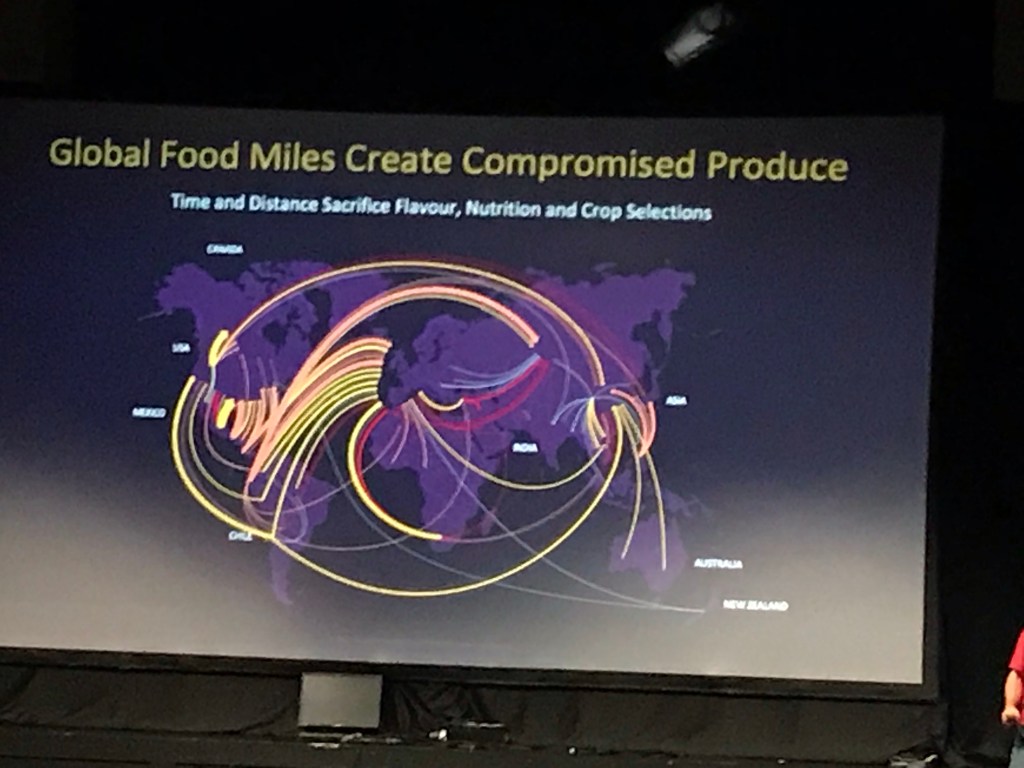
These models supply chains they’re expensive, they use a lot of energy. They have a big toll on the nutrient density in the, in the crops that they deliver. They have a big toll in the flavor they, they have force growers to choose crops selections that are optimized for transportation, rather than optimized for things like nutrition and flavor.
He introduced Tigers Plenty’s First heavily automated large scale vertical warehouse farm, which opened in San Francisco in 2019. The video of the farm is very impressive and inspiring well worth seeking out and looking at.
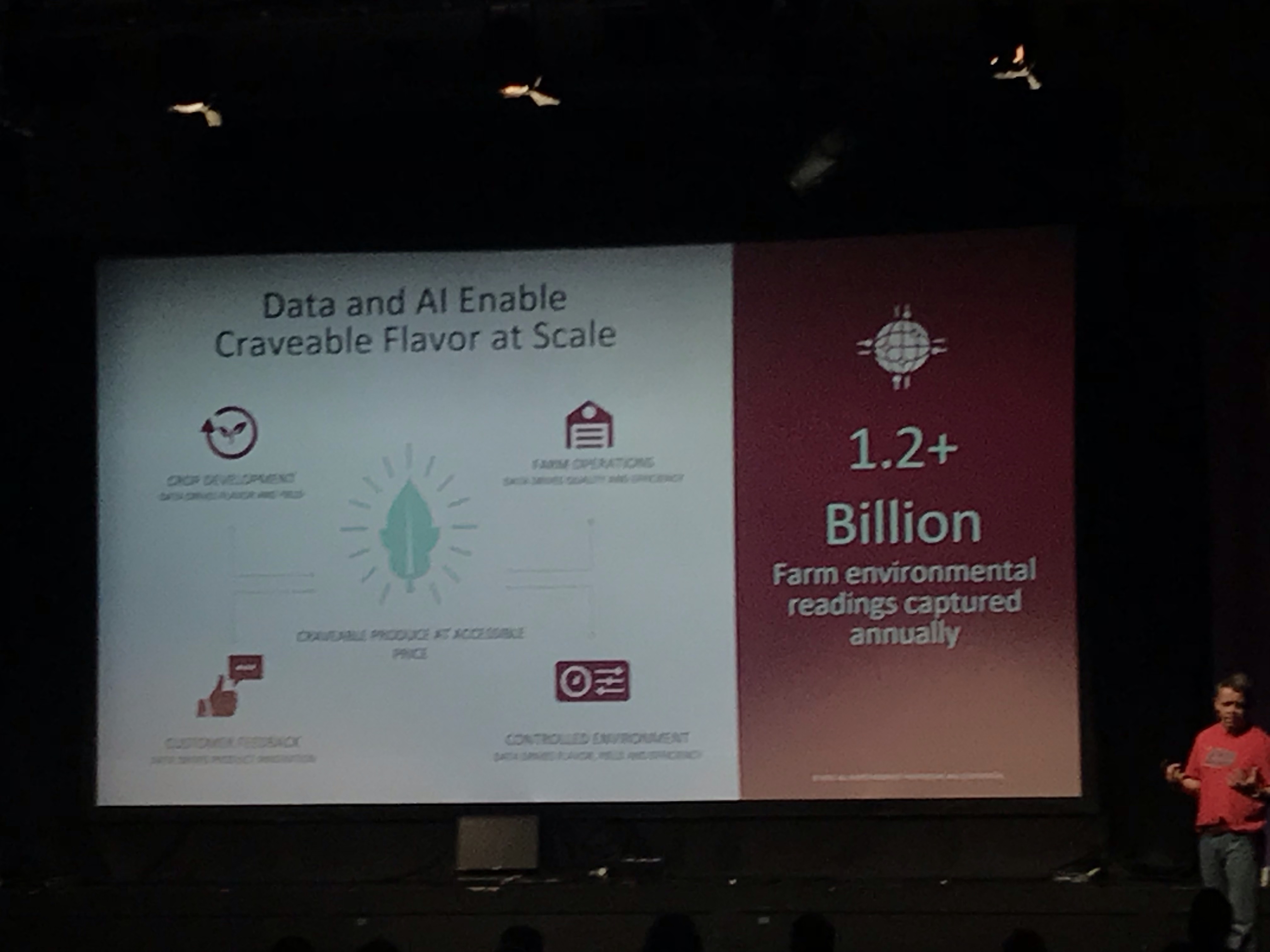
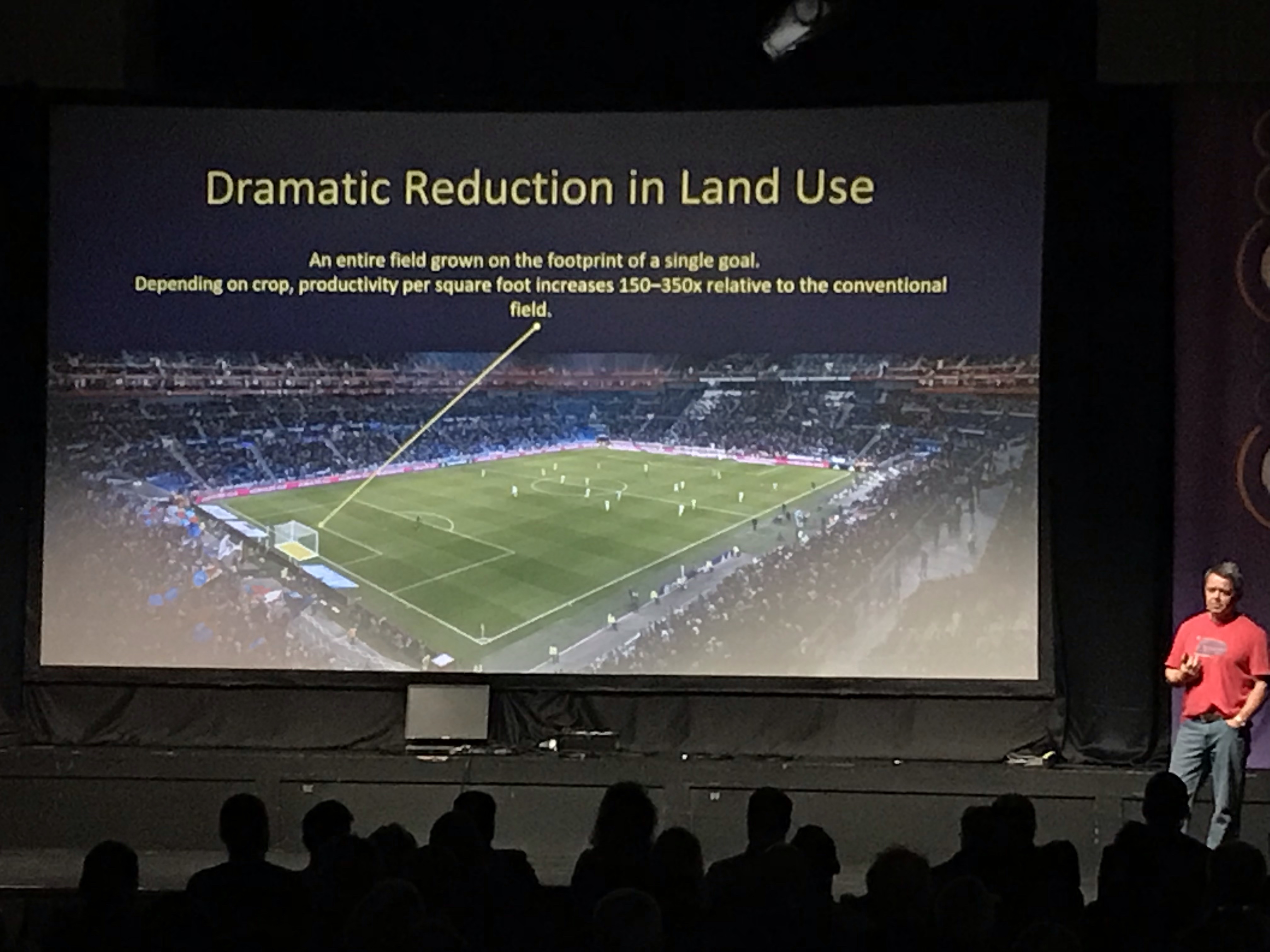
We solve certain problems, the land use, is much much reduced using these vertical farms. Here’s an example of a, of a. If you were to take a normal outdoor field, and let’s say with the size of a soccer pitch a comparable yield could be achieved for 20 farm in a farm the size, the size of one goal.
Also, instead of having those complicated supply chain spread out all over the world, we can grow pack and distribute and in our farms, located adjacent to market. And this gives us a much much fresher produce, and we have much less waste along the way we have much less costs and transportation, and we can maintain much much longer shelf life which also reduces race for the waste for those supplies.
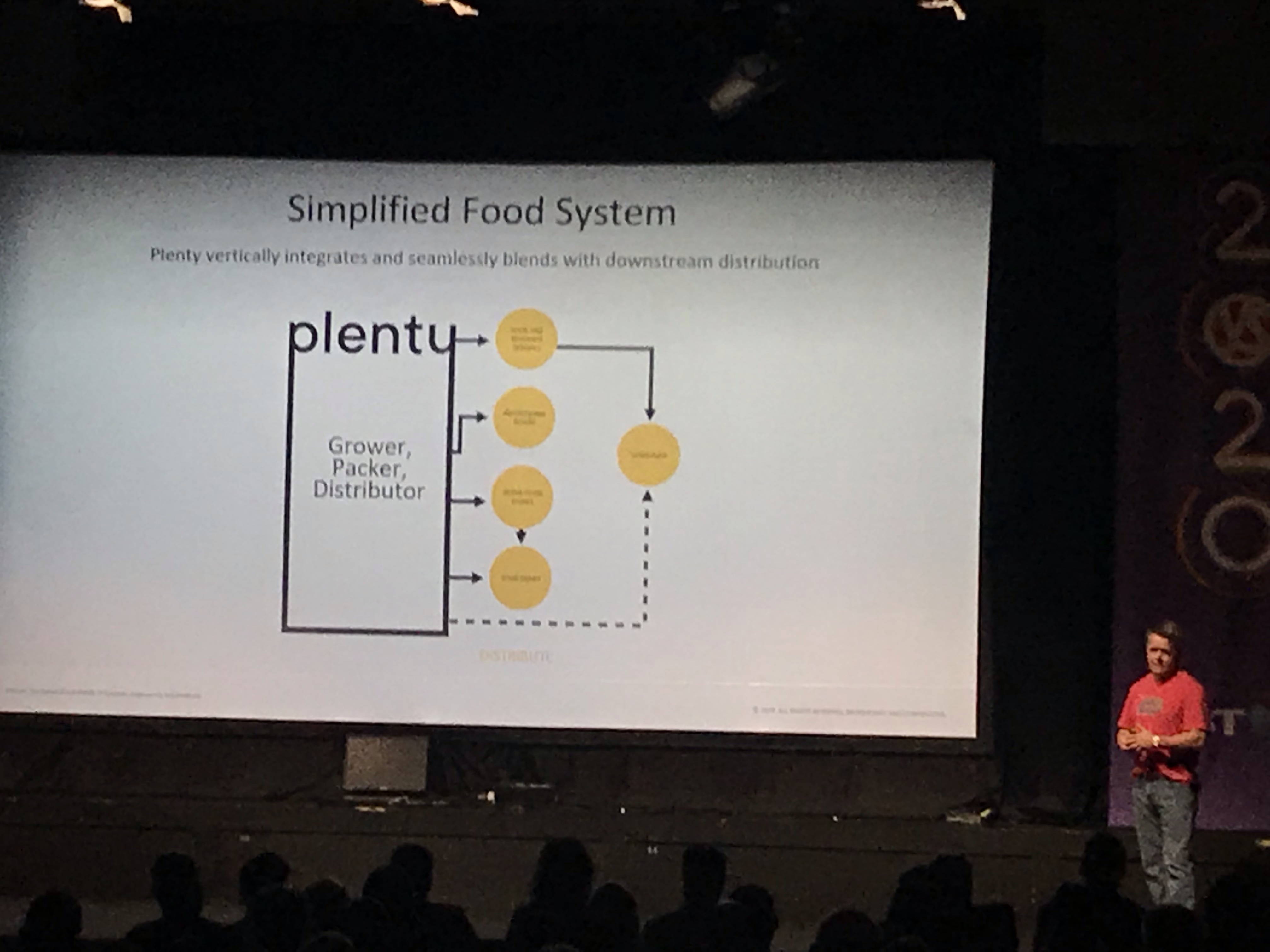
Plenty’s target is from with about a million plant sites throughout the farm and our growth period for our major dramatic phase is 10 days, and we can, we harvest 365 times a year, as a daily. And we operate on less than 1% of the land and less than 5% of the water.
In 2020 we really have to nail our Tigers farm to get it to achieve the level of control and reliability, that we know we can achieve with the platform that we have. And secondly, we need a successful go life of the next level up for our farm who comes in. And as far as the challenges the longer term challenges. And really, in order to achieve the kind of optimization that we want, we realized that we’re only scratching the surface will be know that plants. So being able to perceive plant state at a much much finer granularity of timeand space is very very important that is a perception problem. After that we can then focus on learning, truly optimal control and exploring the space and possible controls for these guys to really drive the performance. we were talking about climate change a lot and a lot of our talks and.
Q&A: Can you tell us a little bit more about how you know farming in this way can help to alleviate mitigate our climate change crisis.
Conor: Sure yeah so I think the biggest factor is the resiliency we’ll provide with farms like this. Where we’re seeing increasing threats to existing food supplies, with water scarcity and draft. So that’s a really big element, I think I’m very personally very excited about the idea that we can actually restore land to its original habitat and maybe achieve carbon sequestration by diversity in that way because we can compress the footprint of farming serves so immensely.
Q&A: That makes sense to me. A final question which is something that you hear about on the locks, people talking about how you know AI is going to take over the world is going to is going to be an Armageddon this time is going to be robots, you know you’re working with this in this field for for many years now what are your thoughts on that well how can you help us to to calm down about this dystopian future people talk about you know putting panic,
Conor: so put me down in the fro AI robotics camp, obviously, and, and there’s an awful lot that we can achieve. I think there’s I read a very good book over the holidays by a fellow professor at UC Berkeley called Stuart Russell, and on human compatibility. And he makes a case where a long way from the kind of superhuman AI that people are sort of fear mongering about. And, but he makes an interesting case for the fact that we should start preparing for the possibility that would would come several breakthroughs are still required, but it’s not too early to start thinking through how to handle it. And so I’m not sure that’s dispelling your dystopian fears or not but I think it’s interesting, think about. In the meantime, there’s an awful lot of great things we can achieve with AI and and the level of automation that we can deliver to achieve these great changes in sustainability and the systems that we rely on is very promising. And we just need to do it the thoughtful way in terms of how we handle the rest of society.
The next speaker was Norman Crowley of Crowley Carbon. A successful serial entrepreneur that brought humour, an Irish attitude and did not hold back on his comments about the lack of Government policy and action on Climate Change. Norman highlighted the opportunity in climate change that is often not identified. A curious juxtaposition of a complex and challenging global issue. He was very eloquent on reducing resource waste and increasing resources efficiency, the problem with the word ‘sustainable’, boring topic that create real change.
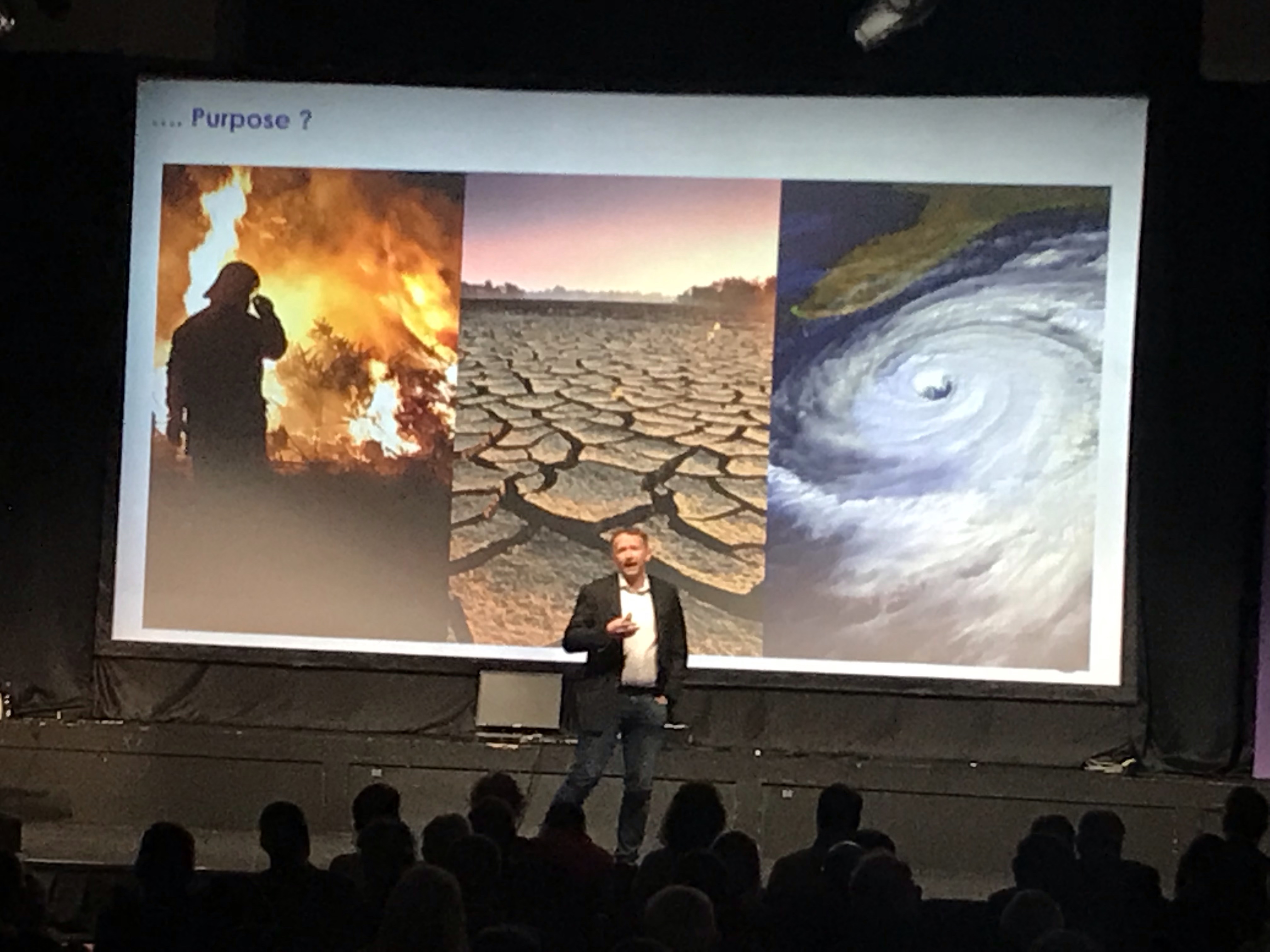
He started his talk with an image of a typical Irish farm so the beginning of the audio that’s the reference.
I recorded Norman’s talk with Otter.io to listen to the 29 minute talk and Q&A session click here. This was recorded on my iPhone for personal reference.
After the event I wandered into the BT Young Scientists 2020 Exhibition which also offered plenty of food for thought. Great to see a plethora of young people with such an appetite for research, curiosity about their interests and the motivation to pursue a question.
Thank you BT.
 Roisin Markham